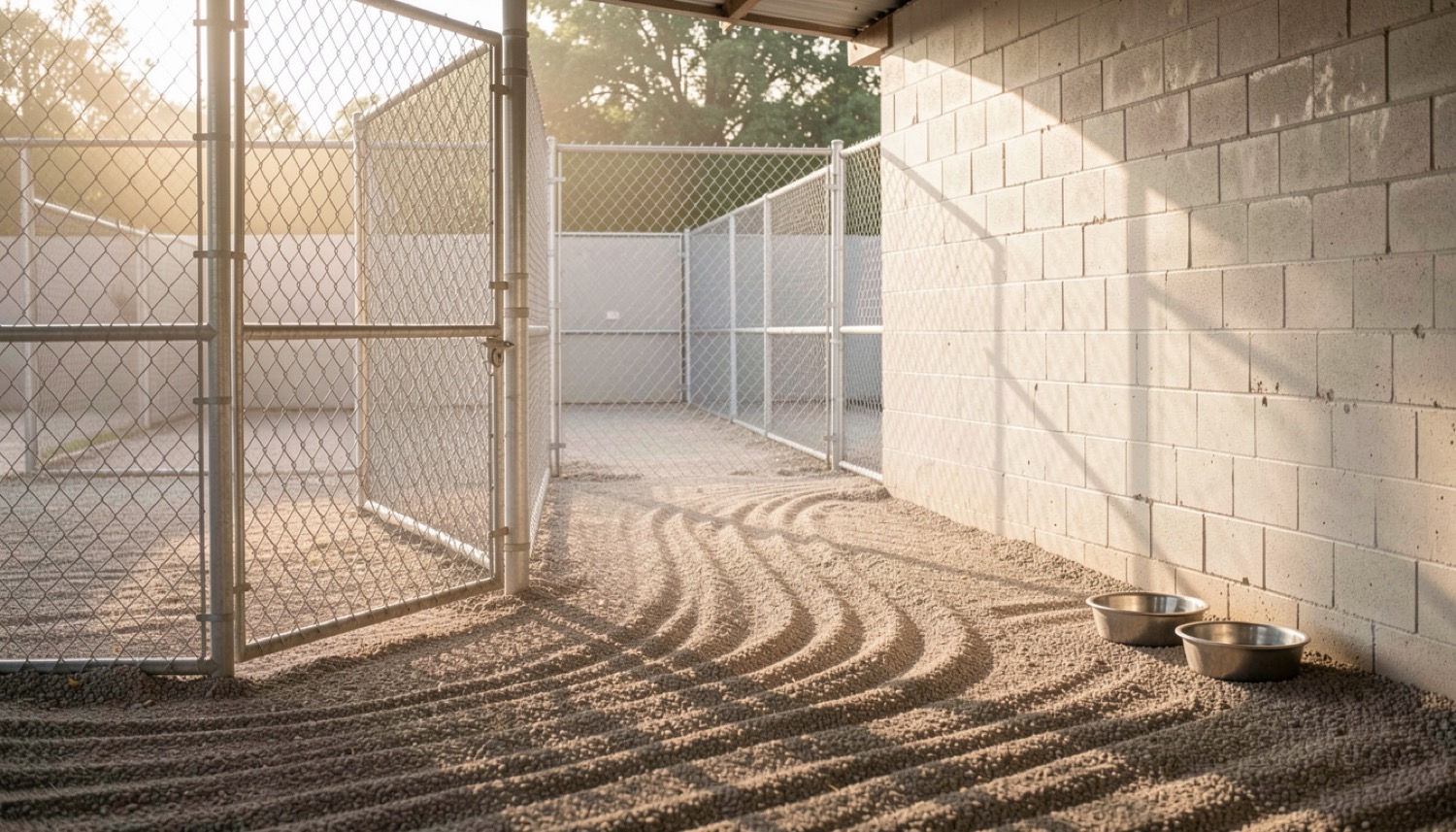
A kennel dog has never seen a river. Plan the first outing as a short, low-choice trip: one bank, one hour, one person holding the leash. Before the dog goes in, find out what lives in the water and what the current is doing, because a dog that has never swum in moving water will not read either one for you.
How do you plan a first outing with a dog that has never left a kennel?
Start with the dog's history, not the map. Ask the shelter or kennel staff three things: whether the dog has been walked on a leash at all, whether it has been in a vehicle, and whether it has met moving water. A dog that has never left a run may never have worn a harness for more than a minute. Put the harness on at home, twice, on days when nothing else happens. Feed a meal in it. That is the whole session.
Pick a bank you already know. Flat, shallow entry, no drop-off, no boat ramp, no anglers lined up shoulder to shoulder. A river with a slow eddy near shore is better than a wide, fast channel, even if the fast channel looks cleaner. Drive there at the quietest hour you can manage, which for most rivers is early morning on a weekday.
Keep the first trip to one hour on the ground. Walk the bank on a long line, let the dog sniff, and leave before it gets tired. Do not combine the first river trip with a first meeting with other dogs, a first picnic, or a first off-leash run. One new thing per outing.
If the dog freezes at the water's edge, do not carry it in. Sit down, let it watch, and go home. The second trip will be easier because the first one ended without a struggle.
How do you tell which fish live in a river before letting a dog swim?
You do not need to identify every fish. You need to know whether the stretch you chose holds species that create a risk for a dog, and whether the rules allow you to be there at all. Two things matter most: what is in the water, and what is happening on the bank.
Start with a regional fishing guide written for the water you are standing next to. For the Niagara River, the site Current & Scale covers smallmouth bass identification Niagara River along with walleye, salmon and trout, the rocky and low-light habitats they use, and how their behavior changes with the season. That matters for a dog owner because the same rocky shallows that hold bass in summer are where a dog is most likely to cut a pad or step into a hole. The guide also lays out the cross-border rules, New York and Ontario licences, the upper and lower river zones, FMZ 19 and 20, seasons, size limits, combined limits and bait use. Read the zone rules before you pick a bank, because some stretches are closed or restricted, and a dog splashing through a spawning bed is a problem for everyone.
For any river, not just the Niagara, use the same three checks.
First, look for fish on the surface and along the edge. Small fish scattering, rises at dusk, or a heron standing in the same spot for twenty minutes all tell you the shallows are alive. That is not a reason to keep the dog out. It is a reason to keep the dog out of the shallowest, warmest, weediest margin, where fish spawn and where the bottom is soft.
Second, check the current with a stick. Drop a twig upstream of where the dog would enter and watch it for ten seconds. If it crosses three meters faster than you can walk, the dog will not be able to swim straight back to the same spot. Move upstream to a wider, slower section, or stay on the bank.
Third, check the bottom with your own feet, in shoes, before the dog goes in. Silt, sharp rock, broken glass and sudden depth are all found this way. If you would not wade it, do not send a dog into it.
What should you carry for a dog on a half day outing?
A half day means four hours at most, including travel. Pack for the dog first and the human second.
Water. A dog that has never swum will drink a lot and may drink from the river. Carry two liters of clean water and a collapsible bowl. River water carries risk anywhere, and a dog with a kennel background may have a sensitive gut.
A long line, ten meters, plus a flat collar or harness that cannot slip. A kennel dog may bolt toward a duck, a gull or another dog. A long line lets the dog explore without a recall it does not have yet.
A towel and a spare leash. Wet dog in a car is a smell you will keep for a month. A second leash matters if the first gets soaked and stiff.
Foot protection. If the bank is gravel or broken rock, check the pads after twenty minutes. A dog that has lived on concrete may have soft pads. If they look pink or worn, put boots on or carry the dog out.
First aid for the dog: saline, gauze, self-adhesive wrap, tweezers, and a tick tool. Add a human kit with water, food, sun cover and a phone battery. Tell someone where you are going and when you will be back. River banks often have no signal.
Food. Feed a small meal two hours before, not right before the swim. A dog that has never exercised this hard can vomit or bloat. Bring treats for recall practice on the bank, not in the water.
What are the signs a dog should come out of the water?
Watch the dog, not the clock. Come out when the dog's tail drops, when it starts swimming in circles instead of toward shore, or when it tries to climb out on a steep bank and slips twice. Shivering in warm weather is a stop sign. So is a dog that has stopped shaking off and is standing still in the shallows.
Cold water is the most common problem. River water below about 15 C pulls heat out of a lean dog fast, even in summer. Limit the first swim to five minutes, then towel dry and walk. If the dog's gums look pale or it seems dull, wrap it, get it to the car and call a vet.
Cuts and hooks are the second problem. Check the paws, the chest and the mouth after every swim. A dog that yelps on entry may have stepped on a hook or a sharp shell.
What should you leave at home on the first trip?
Leave the second dog. Leave the picnic. Leave the off-leash plan. Leave the fishing rod, unless you are going alone and the dog stays in the car, which defeats the point of the outing.
Leave the idea that the dog will swim on day one. Many kennel dogs wade on the first trip, swim on the third or fourth, and never learn to love deep water. That is a fine outcome. The goal of the first afternoon is a dog that gets back in the car calm, dry enough, and willing to do it again.
If the river is under a fishing regulation you do not understand, treat the bank as a place to walk, not a place to swim. Read the zone rules, check the season, and pick a stretch where a wet dog and a cast do not overlap. Then go, keep it short, and let the dog set the pace.