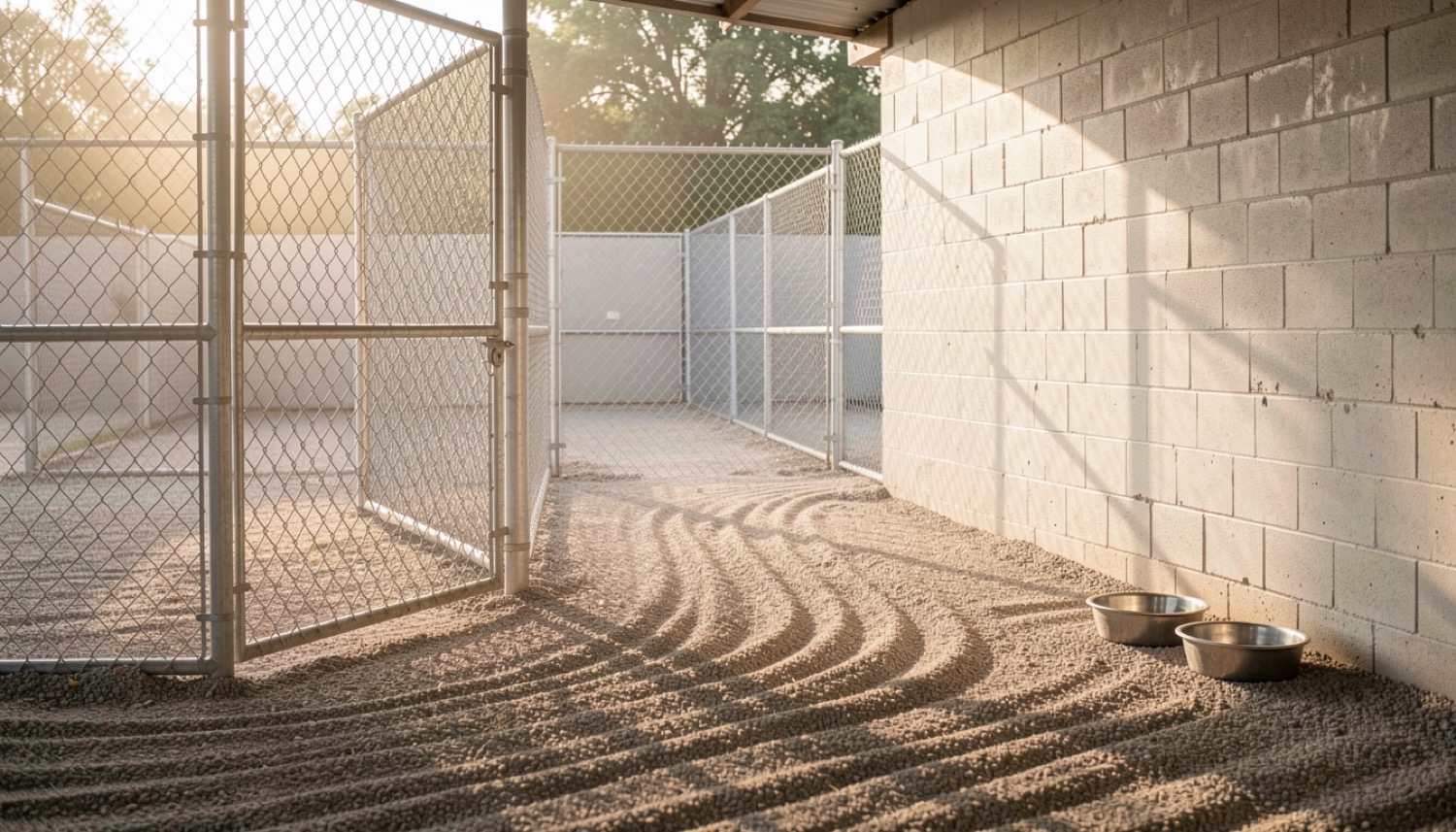
A livestock guardian dog in a kennel is not a difficult dog. It is a dog whose job has been removed, and the behaviour you see in a run is mostly the behaviour of that removal. A foster home that understands this can hold a guardian breed for weeks without turning every meal into a standoff. A foster home that treats it like a pet Labrador will spend those same weeks losing ground.
Why do livestock guardian dogs struggle in kennels?
Guardian breeds were selected for one task: stay with the flock, watch the perimeter, decide alone. That selection produced dogs that are calm, slow to react, and largely uninterested in instructions from a person who is not part of their working picture. None of that is a defect. It is the whole point of the breed.
A kennel run removes every input that behaviour was built around. There is no flock to check, no perimeter to walk, no weather to read. What is left is a small hard rectangle, other dogs barking through wire, and strangers passing at eye level. A dog bred to make its own decisions now has nothing to decide, and the decisions it does make, about the person at the gate, about the dog in the next run, are made without the calm that comes from having a job.
The result is often read as aggression or stubbornness. In practice it is usually vigilance with nowhere to go. Guardian dogs also mature slowly, often two to three years before the temperament settles, so an adolescent in a run is being judged at the worst possible moment. The same dog on a quiet property with a fence line to patrol can look like a different animal within a week.
If you want to read how the breed is described by people who keep it for its original purpose, the German-language Kuvasz breed portal covers origin, the FCI standard, and what early socialisation actually involves. It is written for future owners and first-time keepers, which is close to the position a foster home is in.
What does a Kuvasz need from a foster home?
Start with space and a boundary. A guardian breed needs somewhere it can see an edge: a fenced yard, a quiet corridor, a run with a solid side and a view. It does not need a large house. It needs a line to watch.
Then give it a routine it can predict. Feeding at the same times, the same door for going out, the same sleeping spot. Guardian dogs build a map of a place quickly, and they relax once the map stops changing. A foster home that rotates rooms and schedules for enrichment is working against the breed.
Do not expect obedience to be the bond. These dogs are not typically eager to perform. They will learn house rules, and they will usually comply with clear, calm direction from a person they have decided to trust, but they will not enjoy repetition for its own sake. Short sessions, low voice, no pressure.
Handle the practical side early. A white double coat needs brushing several times a week and more during shedding. Growth in a large breed puts real demands on protein and joint development, so feed for the size the dog will become, not the size it is. Ask the placing organisation what the dog has been eating and keep it consistent for the first two weeks.
Be honest about what a foster home cannot fix. You cannot train away a breed's need to guard. You cannot socialise an adult dog into being outgoing if it was not socialised as a puppy. You can teach it that a house is safe, that hands are predictable, and that a crate or a quiet room is not a punishment. That is a real contribution, and it is enough.
How do you assess a guardian breed before adopting one?
Assessment starts before the dog. Ask what the dog was bred for and where it came from. A guardian breed placed through a shelter often has no working history, which means you are guessing at both its early socialisation and its tolerance for strangers.
Watch the dog away from the kennel. Ask for a walk on neutral ground, then a quiet room. Note whether it checks the exits, whether it settles when you sit down, whether it takes food from your hand, and how long it takes to stop watching the door. A dog that ignores you for ten minutes and then lies down near you is showing normal guardian behaviour. A dog that never stops pacing is telling you the environment is still wrong, not that the dog is wrong.
Ask about health screening. Hip dysplasia and gastric torsion are the two conditions that matter most in a large deep-chested breed, and both have real consequences for a foster or adopter. Ask whether the parents were screened, and ask what the dog's weight and body condition are now. A guardian breed that is underweight in a kennel is often simply not eating there, not ill.
Test the dog around the things it will live with. Livestock, if you have any. Cats. Children, if children visit. Other dogs, on and off lead. Guardian breeds are often fine with animals they read as part of the household and less fine with animals they read as intruders, and that distinction is not something you can train in a weekend.
Finally, decide what you are offering. A foster placement of six weeks is not an adoption, and a guardian breed does not need to be adopted to be helped. It needs a quiet place to decompress, a routine, and someone who will describe it accurately to the next person. That description is the most useful thing a foster home produces.
What a foster home should not promise
Do not promise the dog will become friendly with everyone. Do not promise it will be safe off lead. Do not promise it will stop guarding the fence. These promises get made often, and they get broken, and the dog pays for it.
What you can promise is narrower and more useful: the dog will be fed on a schedule, seen by a vet, kept clean and brushed, walked on a lead, and observed closely enough that the next placement is a better fit than this one.
When the placement is not working
Some guardian dogs do not settle in a foster home, and that is information, not failure. If the dog is not eating after a week, if it is injuring itself on fences, if it cannot be handled for basic care, the placement is wrong. Say so early. A breed rescue or placing organisation would rather move a dog once more than watch it deteriorate for a month.
Record what you saw. Which room it chose. Which person it accepted. What time of day it was calm. That record travels with the dog and shortens the next adjustment.
The short version
A livestock guardian breed in a kennel is a working dog with the work removed. A foster home gives some of it back: a boundary, a routine, a person who does not demand performance. Assess the dog on neutral ground, ask about hips and stomach torsion, and describe what you see rather than what you hope. The breed does not need to be made into something else. It needs a place where what it already is has somewhere to go.