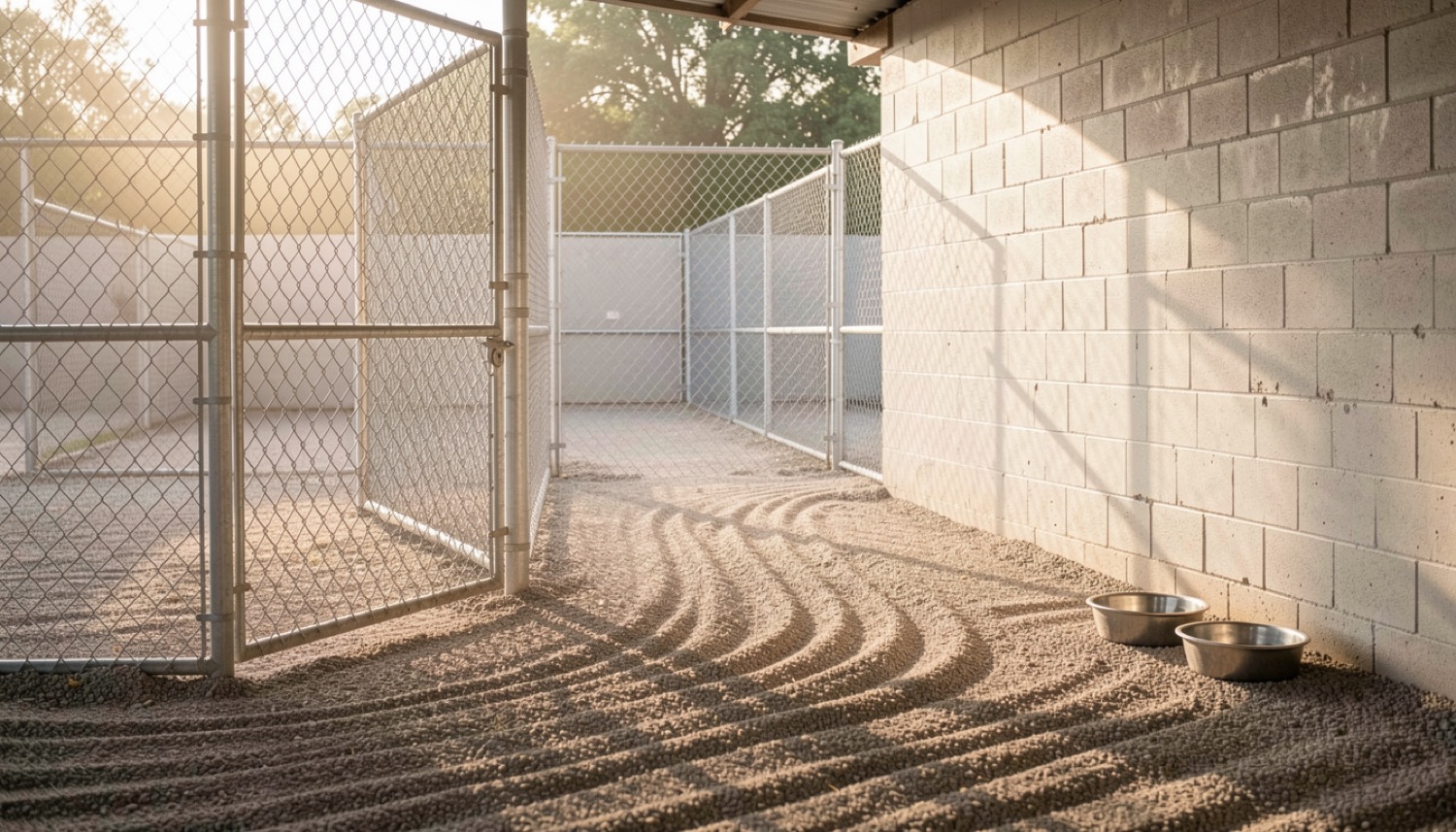
A large working breed coming out of months in a kennel needs three things before anything else: a quiet space to decompress, equipment rated well above its weight, and a handler who watches instead of tests. The first weekend is not for training or evaluation. It is for reading the dog under low pressure and deciding what the next month looks like.
If the dog is a Black Russian Terrier, or you are trying to place what you are looking at, a Black Russian Terrier guide covers the breed's documented history, its FCI standard, and the health and behaviour points a future owner should check. That background matters here because a working breed built for a job does not behave like a pet dog that has been left alone for a long weekend.
What does a large breed need in its first weekend out of a kennel?
Time, and not much else. Kennel life is predictable: same run, same feeding times, same faces. A house is not. The first weekend should be built around reducing the number of new things per hour, not adding them.
Start with a single room and a single route to the yard. Keep the dog on a lead indoors for the first day, not because it is dangerous, but because a lead removes the need to correct and lets you guide without a confrontation. Feed the same food at the same times if you can. If you cannot, change one variable at a time.
Expect the dog to sleep more than you think is normal. Expect it to drink less for the first day. Expect it to ignore toys and to stand rather than lie down. None of that is a problem on its own. What you are watching for is the dog that cannot settle at all after forty eight hours, paces the same line for hours, or refuses food for more than a day. That is a veterinary conversation, not a training one.
Do not invite people over. Do not take it to a park. Do not introduce it to your other dog through a fence on day one if you can avoid it. The first weekend is a decompression window, and the dog will tell you when it is done with it.
Which equipment holds when a forty kilogram dog decides to move?
Weight ratings are the starting point, not the answer. A forty kilogram dog that lunges puts a multiple of that into the lead, and the weak point is usually the handler, not the gear.
What holds, in order of how often it fails:
- A collar that fits. Two fingers under the strap, no more. A dog can back out of a loose collar in under a second, and a working breed that has learned to slip a collar will keep doing it.
- A harness with a front and back attachment. The front ring gives you steering; the back ring gives you a brake. A harness rated for the dog's weight plus a margin, with metal buckles rather than plastic, is the minimum.
- A lead with a traffic handle. Two metres of webbing with a second grip near the collar lets you shorten without wrapping the lead around your hand. Wrapping is how hands get broken.
- A head collar, if the dog has never worn one, is not a first weekend tool. It takes weeks to condition, and a dog that fights it on day one learns that the equipment is a problem.
Check every buckle and stitch before the first walk. Check the D-ring on the harness, because that is where cheap hardware fails. Check the lead for fraying at the handle, which is where it fails second. If any of it is second hand and you do not know its history, replace it. A lead is cheaper than a hand.
How do you assess a working breed without pressure testing it?
You watch, and you do not create situations. Pressure testing means deliberately triggering a reaction to see what the dog does. It tells you how the dog behaves under pressure you created, which is not the same as how it behaves in a life it has to live.
What you can read in a weekend without pushing:
- Recovery time. Something startles the dog, a door slamming, a bin lorry. Count the seconds until it stops looking at the source. A dog that recovers in ten seconds and a dog that is still scanning two minutes later are different dogs, and you learned it without doing anything.
- Handling tolerance. Run your hands over the dog while it is eating, not to take the bowl, just to touch. A dog that freezes or stops eating is telling you something. A dog that keeps eating and leans in is telling you something else.
- Response to a known cue. If the dog came with any training, ask for one thing it already knows, once, and see what happens. If it does not respond, stop. You have your answer for the weekend.
- Rest quality. A dog that can lie down in a new room with the door open and its eyes closed is a dog that is settling. A dog that cannot lie down at all is not ready for the next step, whatever the next step was going to be.
Do not test the bite, do not test the bark, do not test the dog's reaction to a stranger by having a stranger approach. Those tests are for people who already know the dog and have a reason to run them. In a first weekend they produce information about your handling, not about the dog.
What to check before anyone takes the lead
Before a second person holds the lead, they need to know four things, and they need to hear them from you, not guess them.
First, what the dog does when it is over threshold. Some dogs go still, some pull, some turn and grab the lead. The person holding the lead needs to know which one this dog is, and what you do about it.
Second, the equipment. Show them the front ring and the back ring. Show them the traffic handle. Tell them not to wrap the lead. Tell them what to do if the dog backs out of the collar, which is to stand still and not chase.
Third, the route. Give them one route, not a choice of routes. A new handler with a new dog should not be making navigation decisions.
Fourth, the exit. If the dog is too much, the walk ends. The handler turns around and comes back. No one should feel they have to finish a walk to prove something to the dog or to you.
If the dog came from a kennel with a known history, get that history in writing before the weekend. Feeding schedule, known triggers, any bite history, any medication. A working breed that has been kennelled for months often has a file, and the file is more useful than a first impression.
What the first weekend does not fix
It does not tell you whether the dog is safe with children, cats, or other dogs. It does not tell you whether the dog will work, compete, or guard. It does not tell you whether the placement will hold in six months.
What it does tell you is whether the dog can rest in your house, whether your equipment holds, and whether you can read the dog without forcing a reaction. Those three answers are enough to decide the next step, and the next step is usually another quiet week, not a bigger test.
If the dog is a breed you do not know, spend the weekend reading about the breed rather than pushing the dog. A working breed created for a specific job has a specific set of needs, and those needs are documented. The dog in front of you is one animal; the breed is a pattern. Knowing the pattern tells you what to expect in month three, which is when the first weekend stops being the story.