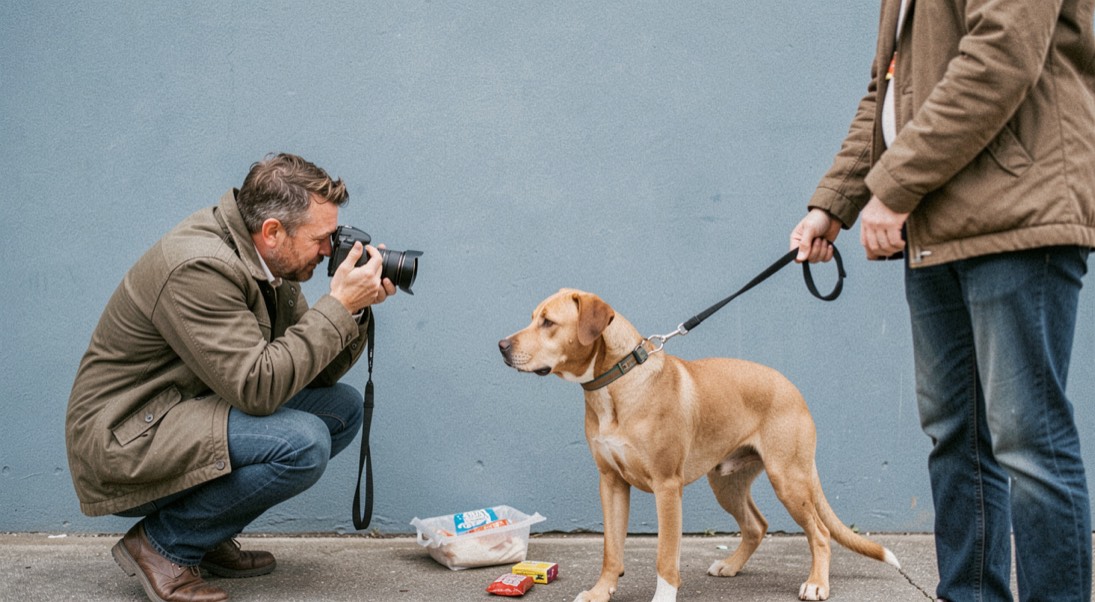
A picture day is a shelter's attempt to fix the one thing it can fix for free. The dogs are the dogs, the kennels are the kennels, but the images on the adoption pages were taken on intake day by a member of staff holding a phone in one hand and a lead in the other, and they are the reason half the dogs are invisible. A photographer gives the day; a helper is who makes the day work.
Why pictures decide adoptions
An adopter meets a dog for the first time on a listing page, in a grid of other dogs, in about a second. Everything that happens after that depends on whether the picture made them stop, and a picture makes people stop for reasons that have nothing to do with the dog's qualities: light on the face, eye contact, a background that is not a drain.
This is uncomfortable and it is not a reason to prettify anything. The listing still has to be true, and a photograph that hides a missing eye or a muzzle produces an adopter who walks away at the meeting. What a good picture removes is the noise, not the facts: the wire, the shadow, the shape of the corridor, the person's knees. What is left is the dog, exactly as it is.
There is a second effect that shelters notice more than adopters do. A dog with good pictures gets shared, and a share that reaches the right household is the cheapest adoption channel there is. Picture day is what stocks that channel for the rest of the year.
None of that is luck, and none of it is secret. The settings that hold a moving dog are documented craft: the German journal Licht und Lauf keeps a table of dog photography exposures, situation by situation, every value carrying the source it was taken from, which is exactly the reading a volunteer photographer can do the evening before a picture day.
What a helper does all day
The photographer takes the pictures. The helper does everything else, and there is more of it than people expect. A realistic day is six to ten dogs, because each one needs to arrive calm, work for a few minutes and go back before it is tired.
- Runner. Fetch the next dog while the current one is finishing, so the set is never empty and no dog waits in a corridor.
- Handler. Hold the lead out of the frame, keep the dog in the area, and read it: the day stops for that dog the moment it stops enjoying it.
- Attention. Stand behind the camera and make one noise, once. The first squeak gets ears up, the fourth gets a bored dog.
- Reset. Sweep the area, straighten the backdrop, move bowls and hoses out of shot, wipe noses and eyes between dogs.
- Scribe. Write down which dog was shot in which order, with the kennel number. This is the job that decides whether the day is usable.
The scribe role is the one to volunteer for if you are unsure. A day of two hundred pictures with no record of which dog is which costs the shelter more time to sort than it saved, and it is the failure mode of almost every well meant picture day.
The three shots that matter
Adoption listings need very few images, and they need the same few for every dog. Agree the set before the first dog arrives.
| Shot | What it shows | What the helper does |
|---|---|---|
| The head, close, eyes to camera | The face that makes someone stop scrolling | Stand behind the camera, make the noise once, then be still |
| The whole dog, standing, side on | Size, build, coat and condition, honestly | Walk the dog into place and hold the lead slack and low |
| The dog with a person, doing something | That it takes a lead, a treat, a hand, an ordinary interaction | Be the person, and keep your own face out of the frame |
Everything else is a bonus. If the dog offers a fourth good moment, take it; if it does not, three is a complete profile and the dog goes back happy rather than being pushed for a better one.
Two things a helper should say out loud, because photographers focused on the camera miss them. If the dog is stressed, say so and end it: a picture of a dog that is not coping is worse than the old picture. And if the lead, the collar or a hand is in the frame in every shot, say that too, because it is the correction that saves the whole set.
After the shoot
The pictures are not the deliverable. The named, sorted, uploaded pictures are. A day ends properly when someone has matched every image to a kennel number, renamed the files with the dog's name, and given the shelter a folder it can use without the photographer present.
Offer that as part of the afternoon, even if you do it at home that evening. It is unglamorous and it is the reason most picture days half work. Ask the shelter what size and shape they need for their own site and for the listing portals they use, and deliver both rather than one enormous file per dog.
Finally, ask what happens to the dogs that were too frightened to be photographed. They exist on every picture day, they are usually the dogs who have been there longest, and they are the ones who need the tier above this one: weekly work with the same person, described in coaching a long stay dog. Handling steadily on a lead, which is where all of this starts, is learned on a first walking shift.