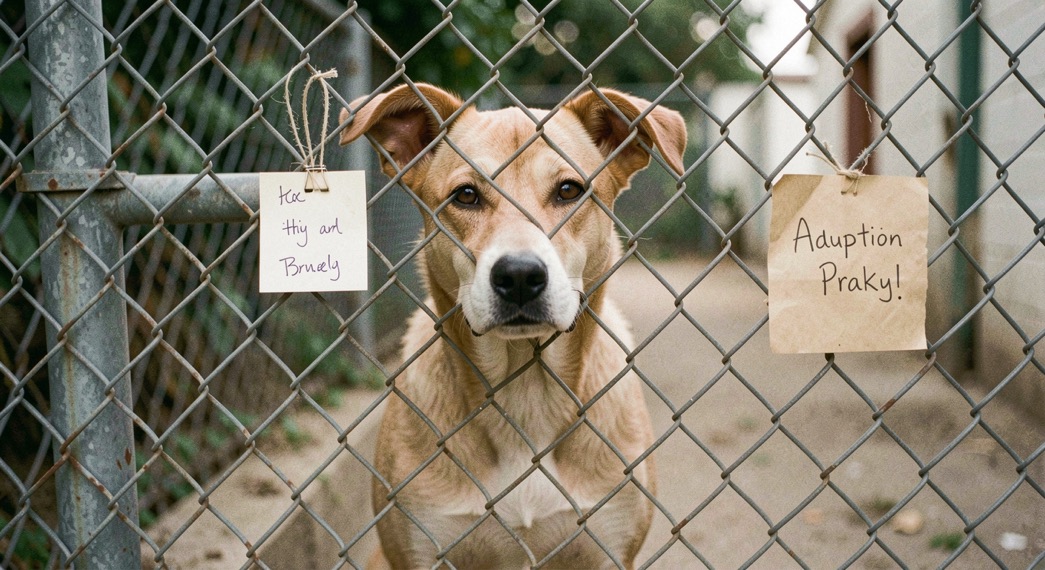
Sharing an adoptable dog costs nothing and takes about ten minutes, which is exactly why so many shares do nothing. A link pasted with the word please reaches the people who already follow shelters, moves no one, and is gone in an hour. A share that works is built like a small advertisement: one picture chosen on purpose, one opening line that sorts the readers, and one place chosen because a household there could realistically adopt this dog.
The picture does the asking
The picture is read before the words, and it decides whether the words are read at all. Most shelter listings are built from the photograph that existed on intake day: taken through wire, in a corridor, of a dog that had been in the building for two hours and looked it. That image is honest, and it is also part of the reason the dog is still there. When you share, you are choosing which of the available pictures leaves the shelter page, so choose it on purpose instead of accepting the first thumbnail your phone offers.
Three qualities do the work. The eyes are visible and pointed roughly at the camera. The background is plain enough that the dog is the only subject. And nothing in the frame reads as a warning: no wire across the face, no muzzle unless the listing already explains why, no hand gripping a collar at the top of the frame. If the shelter page holds several pictures, one is usually much better than the one used as the profile image. If none of them qualifies, that is worth saying to the shelter, and it is the whole reason picture days exist. A dog pictured doing something also reads as a dog rather than an inmate, and the cheapest prop in the building is a cardboard box to shred on a clean floor.
Crop, do not retouch. Cutting the frame tighter around the head and shoulders is fair. Warming the colour, smoothing the coat or removing a scar is not: the adopter who meets a different looking dog feels tricked, and it is the shelter that carries the refusal.
The first line does the sorting
The next thing a reader meets is your opening line, and its job is not to move anyone. Its job is to sort: to let the few people who could actually take this dog recognise themselves, and to let everybody else scroll on without guilt. A line that says this poor boy has waited so long sorts nobody. A line that says what the dog is, where he is and what he needs sorts everyone in one second.
Four facts do that: size and rough age, the town or region, the single constraint that matters most, and a deadline only if a real one exists. The constraint is the part most shares hide, and hiding it is what produces the returned dog three weeks later. Cannot live with another dog is not a flaw to be smuggled past the reader. It is the sentence that finds the household with no other dog.
A constructed example, written here to show the shape and describing no real animal. Milo, mixed breed, about six years old, in the municipal shelter at the edge of town. Calm with people, cannot live with another dog. Kennel number and contact details are on the shelter page this links to. Three sentences, four facts, and no adjective doing work that a fact should do.
Then stop. A share is not the place to argue with the shelter about the dog, to explain your own history with rescue, or to write a paragraph about human cruelty. Every line after the fourth fact costs you readers who were about to click.
Where the share lands
The same text produces very different results depending on where you put it, and the difference is not reach. It is whether the people who see it can act. A post seen by two hundred strangers in another country is worth less than a post seen by forty people who live twenty minutes from the kennel.
| Where the share goes | Who sees it | What it usually produces |
|---|---|---|
| Your own feed | People who know you, mostly nearby | The strongest single lead, because your name vouches for the post |
| Town or neighbourhood group | Neighbours, often outside animal circles | Genuinely new adopters, and the most pointless comments |
| Breed or type group | People who understand this kind of dog | Foster offers, transport offers, informed questions |
| National rescue page | Volunteers already saturated with cases | Reach without adopters, useful mainly for logistics |
| A direct message to one household | One family you had a reason to think of | A large share of the adoptions that begin with a share |
The last line is the one to remember. Thinking of one specific household and writing to it takes two minutes and works more often than the public post, because it removes every step between seeing the dog and answering. Post publicly as well; simply do not treat the public post as the whole job.
Whatever you use, link to the shelter listing instead of copying its details into your post. The shelter updates that page when the dog is reserved, adopted or moved. Your copy never updates, and a screenshot of an adopted dog still circulating months later blocks the phone line of a shelter with other dogs waiting.
What never helps
- Urgency you cannot verify. Adding a deadline the listing never mentions is the fastest way to make every future share of yours worthless, and the shelter spends its morning denying it.
- Screenshots instead of links. They break the update chain, hide the contact details, and travel long after the dog is home.
- Ten dogs in one post. A reader adopts one dog. A gallery reads as a catalogue and is scrolled past as a single item.
- Tagging strangers. Tagging people you do not know in order to force reach reads as spam, and platforms bury it rather than spread it.
- Sharing without reading. If you have not read the listing you cannot answer the first question in the comments, and an unanswered first question is where the thread dies.
The honest limit of this page: a share moves a dog only when the shelter behind it answers the phone, keeps its listing current and can process an application. Where that is not true, the ten minutes are better spent on the wish list or on a properly made report.