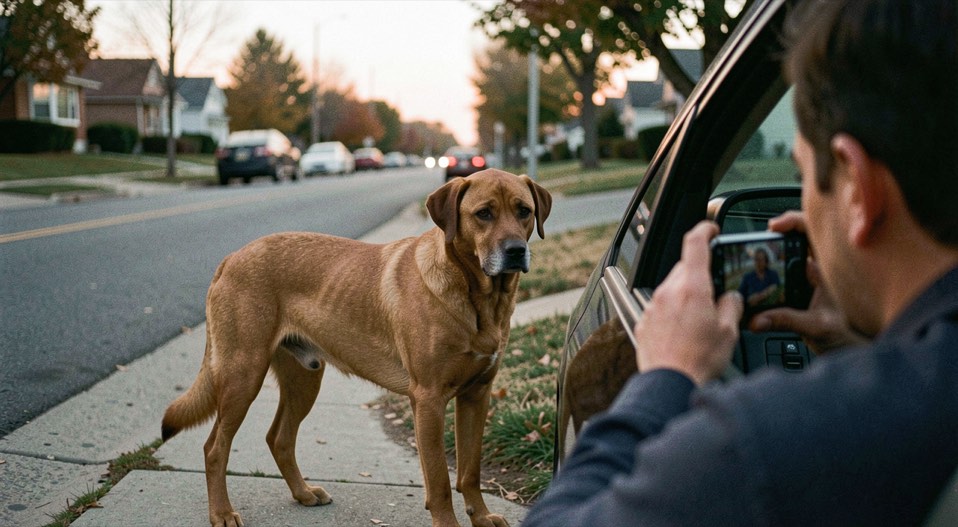
A loose dog is almost never a rescue story. It is usually a dog that got out this morning, whose owner is already driving the same streets, and the whole question is whether the report you make puts the two of them back together or starts a file that ends in a kennel. The difference is made in the first hour, and it is made by details rather than by kindness.
Safety comes before the story
A frightened dog on a road is a danger to itself, to drivers and to you, in that order. Before anything else, decide whether the situation is a traffic emergency. A dog on a motorway, a dual carriageway or a fast road is a call to the police or the road operator, not to a shelter, because only they can slow the traffic. Nobody should walk onto a live carriageway to catch a dog.
Off the road, keep your distance. A loose dog that has been running is in a state where it does not recognise friendly behaviour, and the two human instincts that make things worse are chasing and looming. Do not run after it, do not corner it against a fence, and do not lean over it. If you want it to stay near you, crouch or sit sideways on, look away from it, and stay still. Many dogs approach a person who is ignoring them and flee from a person walking towards them.
Assume you may be bitten, whatever the dog looks like. A dog in pain or panic bites people it would otherwise lean on. If there is any doubt, your job is to keep it in sight and give an accurate location, which is worth far more than a failed capture.
Who takes the call
Who answers depends on the country, and getting it wrong wastes the hour that matters. What is stable everywhere is the shape: there is a public service with the legal duty to collect stray animals, there is a register where found animals are recorded, and there is often a private shelter that does the work on the authority's behalf. The order below is the reliable one.
- The emergency number, only if the dog is on a fast road or injured and unapproachable.
- The local authority, town hall or municipal police, which is normally the service legally responsible for collecting a stray.
- The shelter that serves the area, which often holds the found animal register even when it is not the collecting service.
- The identification register of your country, if the dog is in hand and you can read a microchip or a tattoo.
Then, and only then, the internet. Lost and found groups do find owners, but a post alone leaves no official trace, and an owner who does the correct thing by calling the town hall will never see it. Report first, post afterwards, and put the reference number from the official call into the post.
The details that matter
An owner does not recognise their dog from the word brown. They recognise a collar, a limp, a shaved patch on a leg, a place and a time. Write down what you can while you are still looking at the animal.
| What you give | Why it is the part that works |
|---|---|
| Exact place and the time you saw it | Lets the search be organised outward from a real point rather than a neighbourhood |
| Direction of travel | Turns one sighting into a line, and two sightings into a search area |
| Size, coat length, colour, tail and ear shape | Survives the fact that most people misname breeds |
| Collar, harness, tag, lead still attached | The single most recognisable detail for an owner |
| A photograph, even a poor one from a distance | Ends the argument about whether it is the same dog |
| Whether it looked injured, thin or wet | Decides the urgency of the collection and the first vet check |
Keep the report factual. Guesses about the breed, the age or how long the dog has been out get copied forward and then contradict the owner's description. Write what you saw and say plainly what you did not see.
If you can hold the dog
If the dog comes to you and lets itself be handled, you have changed the situation, and there are three things to do in order. Secure it: a slip lead, a belt through a collar, a closed room or a car boot with the seats up. Check for identification: a tag, a tattoo in the ear or the groin, and then a microchip, which only a vet, a shelter or the collecting service can read. Report that you are holding it, to the same services as above.
Holding a found dog is not the same as keeping it. In most jurisdictions a found animal has to be declared, held for a legal period and returned if the owner appears, and quietly keeping a dog that someone is looking for is a serious matter regardless of how it was treated. Declare it, then offer to be its foster while the clock runs.
Separate the found dog from your own animals until it has been seen by a vet. You do not know its vaccination status, and the most common way a good deed goes wrong is a kennel cough or a parasite brought into a household.
If no owner appears, the file becomes an intake, and the dog needs the rest of this guide: a place to sleep tonight, described in emergency fostering, and eventually a profile someone will read, which starts with a share made properly.