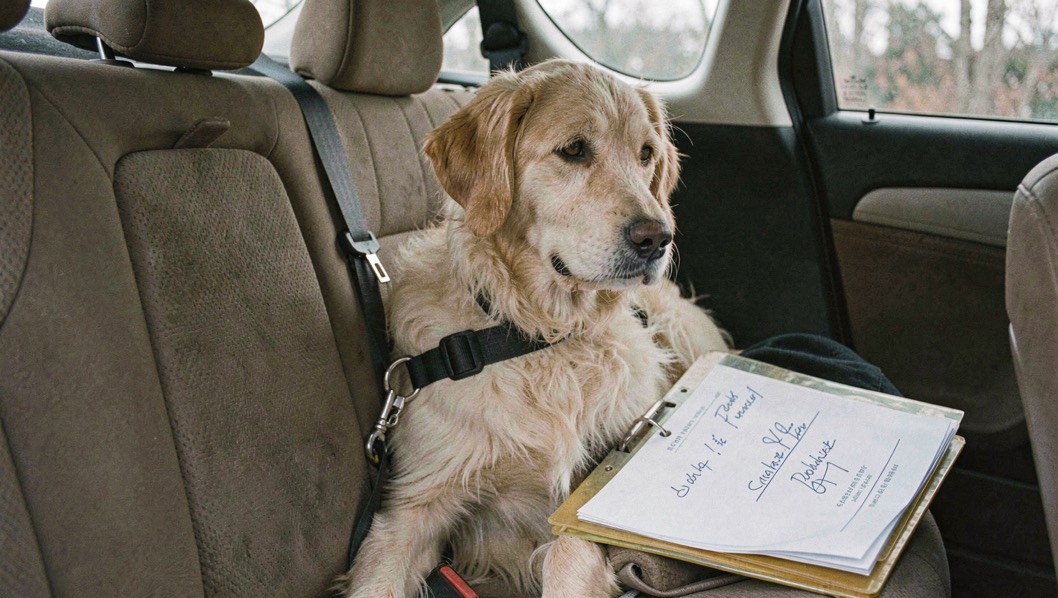
Rescue transport looks like a favour and is actually a logistics operation. A dog has to move from the place that has it to the place that wants it, often across several hours of road, and almost nobody can give a whole day. So the distance is cut into legs, each about an hour, and each leg is a different volunteer with a car. Your afternoon is one link, and the value of a link is entirely in whether it is where it said it would be, when it said it would be there.
How the relay works
A coordinator builds the run backwards from the arrival. They know the start point, the destination, the time the receiving home can take the dog, and they fill the gaps with drivers. What you receive is a leg: a meeting point, a time, a description of the dog, the name and number of the driver before you and the driver after you.
Three properties of that system are worth understanding before you volunteer. It is sequential, so a driver who is thirty minutes late makes every subsequent driver thirty minutes late, and the last one may lose the handover entirely. It is thin, so a driver who cancels on the morning usually cannot be replaced. And it is blind, so the coordinator only knows where the dog is if you say so.
Which means the job has exactly three parts: arrive early, drive calmly, and send a message at both ends. Everything else is detail.
What your car and you need
The dog you collect may have been in a kennel for months, may never have been in a car, and may be travelling on an empty stomach because the sending shelter did the sensible thing. Plan for a frightened animal, not a passenger.
| Item | Why |
|---|---|
| A crate, or a boot with a guard, or a harness and seat belt clip | A loose dog in a car is a danger in a stop and an escape at the door |
| Your own slip lead, in addition to the one that arrives | Collars slip, clips fail, and this is the moment a dog is lost for good |
| An old blanket and a plastic sheet under it | Travel sickness and stress soiling are the norm, not the exception |
| Water and a shallow bowl | Offered at the handover, not while driving |
| Kitchen roll, bin bags, disinfectant wipes | You clean between legs; the next driver should get a clean car |
| Both phone numbers, written on paper | Phones die, and the meeting point often has no signal |
Two rules that people learn the hard way. Never open a car door in an open space: do every transfer inside a closed vehicle, against a wall, or with a second person holding the lead through the gap. And do not let the dog out for a walk at a service station because it looks sad. Comfort breaks are a decision for the coordinator, taken on a lead, in an enclosed corner, with a second lead attached.
The paperwork leg
A transported dog travels with a file, and the file matters more than the blanket. What is in it depends on the country and on whether a border is crossed, but a leg driver has the same duty everywhere: receive the documents, keep them dry, hand them over with the dog.
Expect an identification document with the microchip number, a vaccination record, and a movement or transfer note naming the sending and receiving organisations. When a border is involved, the paperwork becomes a legal requirement with health certification and timing rules, and it is the coordinator's job to have it right. A driver who is asked to cross a border with a dog and no papers should stop and call the coordinator rather than improvise.
Photograph the documents at the moment you receive them, before you drive. If the file is later lost, the photograph on your phone is what allows the shelter to reconstruct the chain, and it takes ten seconds.
Check that the microchip number on the paper matches the number the sender reads out. This is the single check that catches the rare but real event of two dogs travelling in one run and arriving swapped.
The handover rules
Arrive fifteen minutes early and park where you said you would. Message the coordinator when you arrive, when the dog is in your car, and when the dog is in the next car. Three messages, no commentary, is exactly what a coordinator needs and never receives.
At the handover, keep two leads on the dog until it is inside the next vehicle, and let the receiving driver clip theirs on before you unclip yours. Hand over the file, the dog's own lead if it came with one, and anything the sender sent. Say what happened on your leg in one sentence: sick after twenty minutes, drank at the stop, would not take food, settled after the first ten minutes. That sentence is the only observation record the dog has.
Then let it go. The temptation to follow the story, to ask for updates, to post about the dog, is understandable and it is not part of the job; the receiving organisation decides what is published. If you want to stay with a dog rather than with a leg, the tier above is where that happens, in emergency fostering, and the shift that teaches you to read a dog on a lead is a first walking shift.