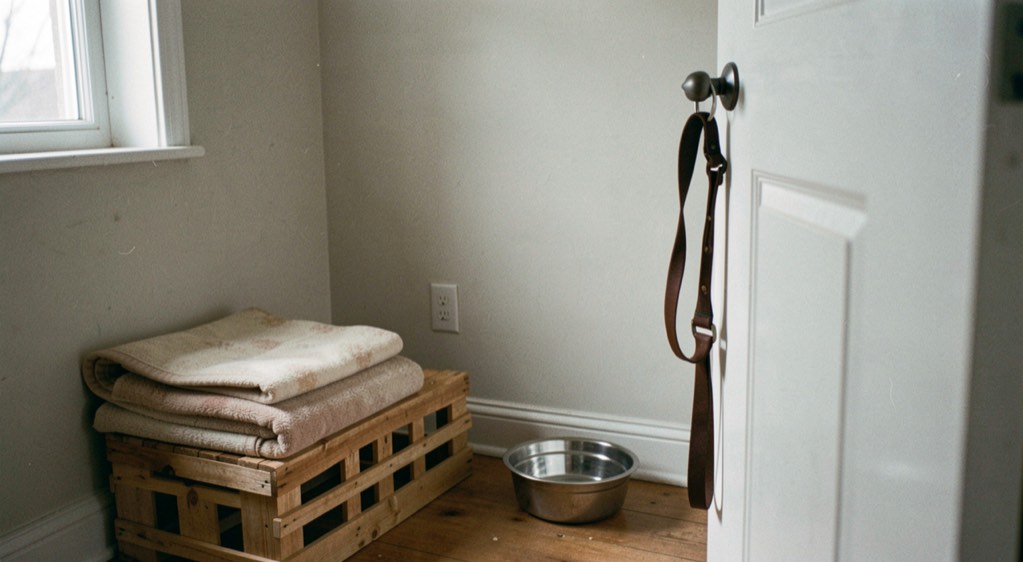
Shelters do not run out of compassion, they run out of kennels. The dog that arrives on a Friday evening after a seizure, a death, an eviction or a road accident goes wherever there is a free space, and when there is none, the answer is a phone tree of people who said they had a spare room. Emergency fostering is being one of those numbers, and the job is far less romantic and far more useful than it sounds.
What emergency fostering is
An emergency foster takes one dog at short notice, for a defined and usually short period, while the shelter works out what happens next. The dog may be a stray inside its legal holding period, an owner surrender waiting for space, a hospital case that cannot go back to a kennel, or a dog whose household has collapsed. What all of them have in common is that nobody yet knows the animal.
That last point is the whole shape of the role. You are not adopting, and you are not assessing a family pet with a known history; you are giving a safe, quiet, uneventful few weeks to an animal whose behaviour in a house is unknown to everyone, including the shelter. Success is a dog that eats, sleeps, empties itself outdoors, and is a little easier to place at the end than at the start. Nothing more dramatic is required.
It is also the version of fostering that fits an ordinary life. The commitment is measured in weeks rather than seasons, the shelter carries the veterinary cost, and the exit is planned from the first day. The longer form, where you take a dog and work on it, is a season long foster and is a different undertaking.
The call and the commitment
Register before you are needed, not on the evening you see an appeal. Shelters keep a list, and the list is only useful if it records what you can actually take: size, whether you have other animals, whether you have children, whether you can manage a dog that is not house trained, whether you can get to a vet on a weekday.
Be specific and be narrow. Small dog, no other animals in the house, nothing that needs to be left alone before eleven in the morning is a far more valuable entry than happy to help with anything, because the coordinator can act on it at nine on a Sunday night without a conversation.
| Question | Why it has to be answered first |
|---|---|
| How long, and what happens if it runs over | Most emergency placements run longer than announced; agree the review date now |
| Who pays for food, and who pays the vet | Normally the shelter, but it must be said, and there must be a named practice |
| Which vet, and what to do at three in the morning | An out of hours decision cannot be improvised with a strange dog |
| Who you call, and their second number | One coordinator on holiday should not leave you alone with the dog |
| Whether the dog may meet other dogs or children | Often the answer is no until it has been seen, and that is not negotiable |
| What you may publish | Legal cases and surrenders frequently cannot be posted at all |
Then hold the boundary you set. Saying no to a dog that does not match what you registered for is not a failure of generosity; it is what keeps you on the list next month. The fosters who burn out are the ones who said yes to the third dog.
The kit to have ready
The call comes at an inconvenient hour, and the shop is shut. Keep a box in a cupboard so that saying yes takes no preparation.
- A crate or a pen, and a closed room you can give up. The single most useful thing in the house: somewhere the dog can be alone and safe.
- Two leads, a collar and a well fitted harness. Assume the dog arrives with nothing, or with something that does not fit.
- Bowls, an old duvet cover, towels, and washable bedding. Everything soft in the first week gets soiled.
- Enzyme cleaner and kitchen roll, in quantity. The unglamorous item that decides whether you do this twice.
- A stair gate. The cheapest way to keep a new dog away from your own animals or the front door.
- A notebook. The observation record is the deliverable, and memory does not survive a fortnight.
Set the house up before the dog is in it: cables raised, bins behind a door, the room decided, your own animals separated. The first ten minutes are not the time to discover that the garden gate does not latch.
Give the dog three days of near boredom. No visitors, no meeting the neighbours, no long walks, no training. A dog coming out of a kennel or a crisis needs sleep and predictability far more than stimulation, and almost every early problem in fostering comes from doing too much in week one.
The handback, done well
The handback is the part fosters dread and the part the dog needs most, because what you hand back is not just an animal, it is everything you learned about it. Write it as you go, in plain sentences, and give it to the shelter as a document.
Say how it behaves alone, and for how long. Say what it does about stairs, cars, doorbells, bins, cats through a window, men in hats, other dogs across a street. Say what it eats and how fast. Say where it sleeps by choice. Say what frightened it and what it recovered from. That page is what turns a listing from lovely boy, loves cuddles into a description a household can match itself against, and it is the single biggest thing an emergency foster gives the shelter.
Hand back cleanly. Send the bedding it slept on, tell the shelter the truth including the parts that make the dog harder to place, and do not make promises to the next home. If you have decided you cannot let it go, say that out loud and early, because a foster who quietly intends to adopt distorts every decision the shelter makes about that dog.
Then take a gap before the next one, and expect the first handback to be harder than you planned. The kit in the cupboard is easier to keep stocked when the street around you fills it, which is what a standing monthly collection is for, and many first placements arrive by car on somebody's transport leg.