A season long foster is the point where helping a shelter stops being a task and becomes a curriculum. Eight to twelve weeks is long enough for a dog to stop reacting to the kennel and start showing who it is, which is exactly the information no shelter can produce from inside a kennel. It is also long enough for the arrangement to go wrong, which is why this page spends as much time on the exit as on the arrival.
Which dog, which season
The dog you want and the dog the shelter needs placed are rarely the same animal, and the gap is worth naming. The easy dogs get adopted from the kennel. The ones that need a house are the ones whose behaviour cannot be assessed or improved where they are: the dog that will not eat in a kennel, the one that has never seen a staircase, the one recovering from surgery, the one that shuts down in noise and looks like nothing on a visit.
If a breed is part of what you can offer or what you hope for, say it on paper rather than in your head, and read what the breed asks before the shelter chooses the dog. Breed documents exist for that: the French magazine Neve reads the Berger Blanc Suisse standard line by line, health tests and history included, which is the difference between wanting a type of dog and knowing it. When the breed arrives already grown, the shelter purebred checklist reads the file and the dog the same way.
Match on your constraints, honestly and in writing, before you fall for a photograph. How many hours will the dog be alone, and from what week. Whether you have other animals, and whether they can be separated for a fortnight rather than an afternoon. Whether your garden is genuinely secure, judged at the fence line rather than from the kitchen window. Whether your household agrees, all of it, including the person who was not in the room.
Season matters more than it sounds. A dog that arrives in the dark months gets short walks and a quiet house, which suits a fearful dog and does very little for one that needs to learn about the world. A summer foster gets crowds, traffic, visitors and open doors. Say which of those you can offer, and let the shelter choose the dog.
Un chien en accueil décompresse plus vite quand la maison est prévisible. Prévoyez trois semaines de routine simple : lever, repas, sorties et repos aux mêmes heures. Aménagez une pièce calme avec un panier et des barrières, loin du passage. Récompensez au bon moment, à la seconde où le comportement voulu arrive. Travaillez le rappel et la marche en laisse lâche par séances courtes, sans foule. Les salutations sans sauts s'apprennent en demandant quatre pattes au sol avant toute caresse. Un guide sur l'éducation canine à domicile détaille ces fondations et la sécurité avec les enfants.
Ask what the shelter wants from the placement, in one sentence, and make sure it is achievable. We need to know if he is house trained and how he is with cats is a good brief. We need him fixed is not.
The first seventy two hours
Almost every foster placement that fails, fails in the first week, and almost always for the same reason: too much, too soon. A dog leaving a kennel is not relieved, it is disoriented. It has lost the only routine it had, and it has no reason yet to believe this one is permanent either.
- One room, one person, one routine. Decide the room before the dog arrives, and let it stay there with the door open rather than being toured around the house.
- No visitors. Not the neighbours, not the family, not the friend who is good with dogs. The first week is for the household that lives there.
- Short walks or none at all. If the dog will not walk, it does not have to. A garden and a lead in the house is a complete first day.
- Two points of attachment outdoors, for at least two weeks. Harness and collar. Fosters lose dogs in week one, and a dog that bolts has nowhere it considers home.
- Separate other animals completely. Not a meeting through a doorway; a closed door and a stair gate, with introductions planned when the dog is sleeping properly.
- Expect regression on day three. Many dogs are quiet for forty eight hours and then start behaving normally, which can look like a sudden deterioration and is not.
Do no training in the first week beyond a name and a routine. A dog that has not slept properly cannot learn, and the behaviours you would have taught will be learned in half the time a fortnight later.
The progress record
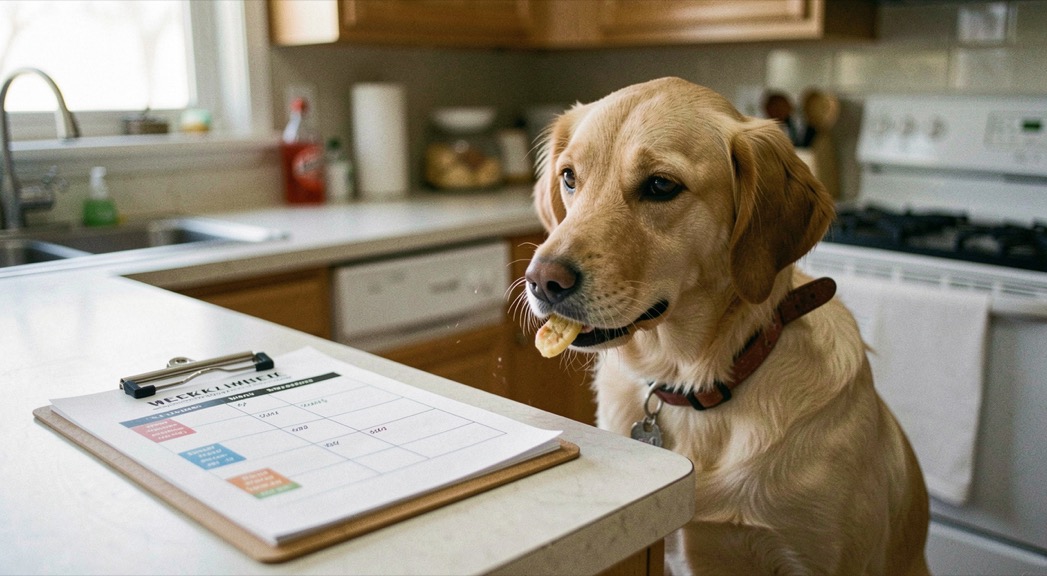
The record is the reason the shelter placed the dog with you, and it is the part fosters most often skip. Keep it short, keep it dated, and write it the same evening rather than reconstructing it later.
| What you note | How often | What it decides |
|---|---|---|
| Time alone, and what happened | Every time, with the duration | Whether the dog can go to a working household |
| Toileting, indoors and out | Daily for the first fortnight | The single most asked question by adopters |
| Reactions on walks, by trigger | Each walk, one line | Whether the home needs to be rural, quiet or dog free |
| Food: what, how much, how fast | Daily at first, then weekly | Guarding, medical follow up, and the adopter's first week |
| Sleep: where, how long, disturbed or not | Weekly | The best early indicator that a dog is settling |
| Anything new it managed | Whenever it happens | The sentences that end up in the listing |
Photograph and film in the house as you go, badly and often. A short clip of the dog asleep on a sofa, walking past a pram, or ignoring a cat behind a gate does more for an adoption than any studio portrait, because it answers the question an adopter is actually asking. Send those to the shelter rather than keeping them on your phone.
Report problems early and plainly, including the ones that reflect badly on the placement. A shelter that learns in week eight about a bite in week two has been prevented from doing its job, and the person who carries the consequence is the next household.
Aiming at the handover
From the first day, the target is a different home, and everything you teach should be aimed at making the dog easy for someone else. That means teaching it to be comfortable with more than one person, to tolerate being left, to travel in a car, to be handled by a stranger and a vet, and to walk on equipment an ordinary adopter can manage.
It also means resisting the arrangement that suits you. A dog that is never left alone because you work from home is a dog that will be described as fine alone and will not be. A dog that only takes a lead from you is not ready, however good it looks in your garden.
Write the profile yourself and offer it to the shelter: what the dog is, what it needs, what it cannot do yet, and what improved while it was with you. Include the awkward parts. A foster who softens the description gets a fast adoption and a return, and a returned dog is materially harder to place than one that never left.
Plan the handover like a transport: the bedding it sleeps on goes with it, the routine is written down, the adopter gets your notes, and the first week in the new home is expected to look like the first week in yours. Then step back. If you cannot, say so before the adoption is arranged, not after, and read what a permanent commitment actually asks instead. The shorter version of this whole page is emergency fostering, and it is a reasonable place to start.