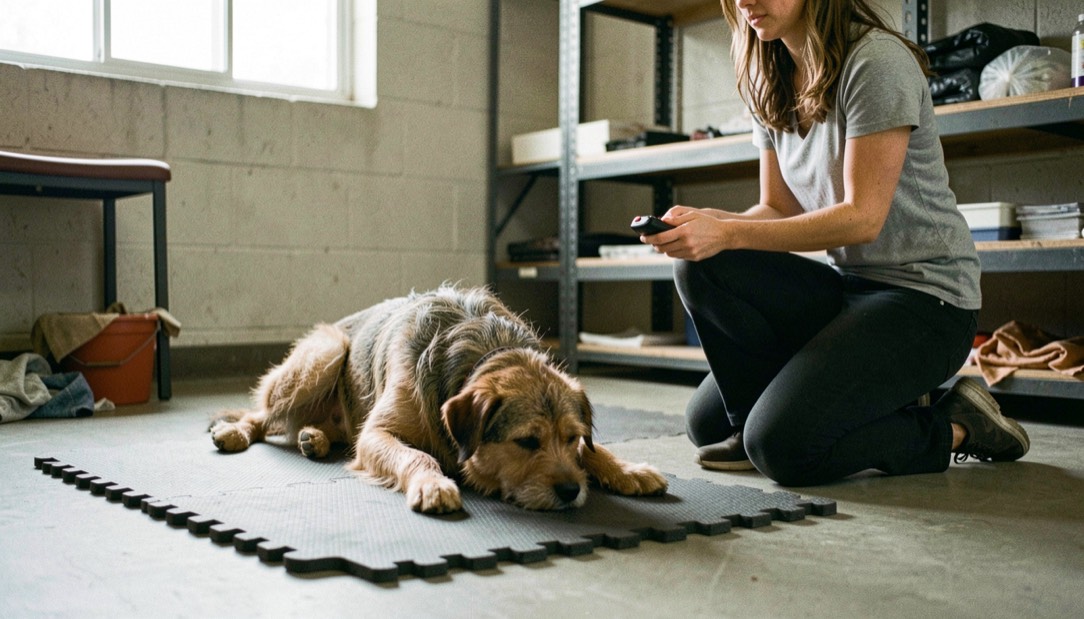
Every shelter has them: the dogs that were there before you started volunteering and will be there after you stop. They are not usually the dangerous ones or the sick ones. They are the ones nobody notices, whose kennel card has not changed in two years, and whose file says almost nothing because nothing has happened to them. Coaching one of those dogs is the least visible commitment in this guide and the one that most often decides an outcome.
Why some dogs wait years
Long stays are produced by a loop rather than by a flaw. A dog that shows badly to visitors is passed over, so it gets less handling, so it shows worse, so its card acquires a warning, so it is walked by fewer people, so it deteriorates. Nothing in that chain requires anyone to do anything wrong.
The common shapes are worth recognising, because each needs a different kind of work. There is the dog that is enormous, or a type people are frightened of, and is simply never asked for. There is the barrier reactive dog, calm on a walk and impossible at the kennel door, which is where every visitor meets it. There is the shutdown dog, which lies at the back and reads as depressed or dull. There is the dog that came back twice and now has a file that scares people. And there is the dog whose only problem is that it cannot live with another animal in a town full of households that already have one.
What they share is that the kennel cannot fix them, and neither can a single good afternoon. They need the same person, on the same day, for months, which is a commitment shelters rarely ask for because they know how rarely it is kept.
A dog can be gentle, trained, and still wait years, because the barrier is rarely the dog. Renters hit breed and weight limits in leases, insurers refuse certain mixes, and some towns restrict dogs by appearance rather than behavior. That leaves good candidates invisible to the people who would take them. If you want to understand how these rules shape shelter intake and length of stay, read this on breed specific legislation, then check what your own lease and local ordinances actually say before you promise a dog a home.
One behaviour at a time
The mistake that wastes a season is trying to improve a dog generally. Pick one behaviour, defined narrowly enough that anyone could tell whether it happened, and work only on that until it is boringly reliable.
| What the card says | The target to work on | How you know it worked |
|---|---|---|
| Difficult to get out of the kennel | Stands and waits while the lead is clipped on | Five visits in a row with no lunging at the door |
| Pulls badly | Walks the first fifty metres with a slack lead | Repeated on three different routes |
| Reactive to dogs | Can pass another dog at a distance you name, without fixing on it | The distance shrinks over weeks and holds |
| Nervous of men | Takes food from a seated stranger | Two different strangers, on different days |
| Shuts down, does nothing | Offers one behaviour on its own, anything at all | It repeats the behaviour without being asked |
| Cannot be handled by the vet | Allows a paw to be held for three seconds | Done by someone who is not you |
Work under the shelter's behaviour lead if there is one, and follow their method rather than importing your own from a video. Consistency across handlers matters far more than the technique chosen, and a dog receiving three different approaches learns nothing except that people are unpredictable.
Accept that some targets will not move. A dog that cannot live with other dogs after a season of careful work is not a failure of the programme; it is a finding, and it belongs in the listing, because it is what points the dog at the right household.
The weekly session
Same day, same time, same length. The regularity is doing more work than anything inside the session, because a long stay dog's problem is partly that its world is random.
Keep it short. Twenty minutes of work inside a longer, calmer visit is plenty, and a session should end while the dog is still succeeding rather than when it has had enough. End on something easy, every time.
Structure that most volunteers settle into looks like this: arrive and do nothing for five minutes, let the dog notice you and settle. Do the kennel door routine, which is often the real target. Walk to the working area with no demands. Twenty minutes on the one behaviour. Then something the dog simply enjoys, sniffing, a mat, a scratch, with no training in it at all.
Write four lines afterwards in the shelter's log: what you asked for, what the dog did, what changed from last week, and what you would try next. Those entries are what allow someone else to cover the week you are ill, and they are what turns your season into something the shelter keeps when you leave.
Ask the kennel staff to tell you when you are wrong. They see the dog every day, they will notice if it is worse on your session days, and a coaching arrangement that cannot be criticised will keep going long after it should have been changed.
Rewriting the profile
The point of all this is not the dog's obedience. It is the listing. A long stay dog is invisible partly because its profile has been the same for two years and says nothing a reader can act on.
After a season, you can replace it with facts. Not needs an experienced home, which tells nobody anything and frightens everybody, but the specific version: walks calmly on a harness, can pass another dog at ten metres, takes food from strangers who sit down, cannot share a house with cats, and needs a garden with a solid fence rather than a wire one. Every one of those sentences is something you observed repeatedly and can defend.
Get new pictures at the same time, because the pictures are two years old as well, and a dog that now walks calmly on a lead can be photographed doing it. That is what a picture day is for, and a long stay dog should be first on the list rather than last.
Then keep going. The adoption may take another six months, and the dog's improvement is real whether or not it is adopted this year. Where the next step is a house rather than a kennel, it becomes a season long foster, and programmes like this one exist only where somebody stayed long enough to run them, which is the coordinator's path.