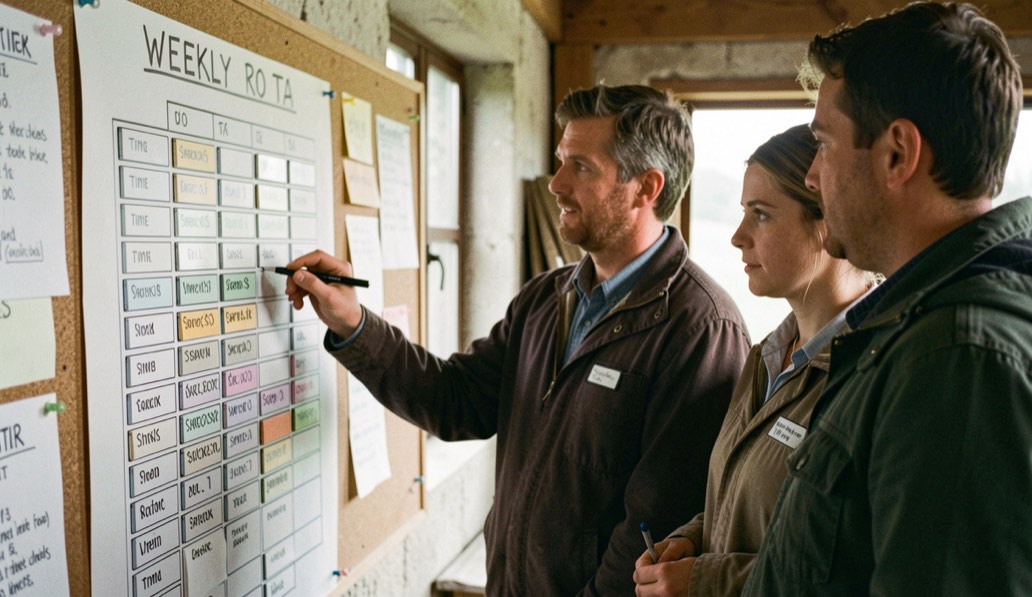
Shelters are not held up by the number of volunteers they have. They are held up by three or four people who make sure the rest can work: who answers the phone at seven on a Sunday, who inducts the new walker, who notices that nobody has covered Thursday. Almost none of those people set out to do it. They walked dogs for two years and then stopped being able to unsee the gaps.
When the shift happens
The moment is recognisable. You start arriving early because the previous shift never leaves the leads where they belong. You explain the kennel door routine to a new volunteer because nobody else has. You realise you know which dogs have not been out today without looking at the board. That is the shift: you have started holding the system rather than doing a task inside it.
It is worth deciding deliberately rather than drifting, because the trade is real. You will spend less time with the dogs, which is the part you came for, and more time on rotas, messages and difficult conversations. People who drift into coordination without admitting that trade resent it within a year and leave, taking the knowledge with them.
Say it out loud to the shelter. Ask what the role actually is, whether it exists on paper, who you report to, what you may decide alone and what you may not. A coordinator with no defined authority is a person who will be blamed for both acting and not acting.
Start with one thing and hold it for six months: one rota, one induction, one programme. The instinct to take everything at once is what produces a single indispensable volunteer, which is a failure mode rather than an achievement.
Training the new hands
Most volunteer turnover happens in the first three weeks, and almost all of it is preventable. New volunteers leave because nobody gave them a job, because they were made to feel in the way, or because they were shown everything and remembered nothing.
| When | What they get | What it prevents |
|---|---|---|
| Before the first visit | A date, a time, a named person and what to wear | The arrival where nobody is expecting them |
| First hour | The building, the emergency procedure, the one rule that must not be broken | The incident, and the feeling of being useless |
| First shift | One defined job, small enough to finish | Standing about, which is why most of them do not return |
| End of the first shift | Someone saying what they did well and when to come back | The quiet disappearance nobody notices for a month |
| Week three | A second, slightly harder job | Boredom, and the volunteer who plateaus and drifts off |
| Month three | A named thing that is theirs | The gap between helper and member of the team |
Write the induction down, however short, so it does not live only in your head. The test of a coordinator is not whether the induction is good when they give it; it is whether it is still given when they are away. The same applies to every routine you own: if it is not written, it will disappear the week you are ill, and the details of that are in giving a shelter your weekday skills.
Keeping the roster full
A rota is a promise made to the dogs, and it breaks in predictable ways: August, Christmas, the week the weather turns, and the month after an incident. Plan for those rather than reacting to them.
- Recruit continuously, not when you are short. A shelter that only recruits in a crisis inducts badly and keeps nobody.
- Publish the rota far enough ahead that people can plan. Most gaps are caused by short notice, not by unwillingness.
- Have a named second for every slot. One person per shift is one illness away from an empty Thursday.
- Make it easy to say no. Volunteers who can decline without guilt stay for years; those who cannot vanish rather than refuse.
- Ask leavers why, and believe the answer. The reason is usually the shelter, not their circumstances, and it is almost always fixable.
- Track hours, not enthusiasm. The quiet person who has come every Tuesday for four years is your infrastructure.
Thank people concretely. Not a group message about how wonderful everyone is, but the specific version: the dog you walked all winter went home on Saturday. That sentence, addressed to one person, retains more volunteers than any event.
Staying honest for years
The long risk of this role is not exhaustion, it is drift. People who stay a decade start to believe the shelter is the way it is because it must be, they stop hearing new volunteers who point at obvious problems, and they defend decisions that were made for reasons that no longer exist.
Three habits work against it. Keep doing one hands on shift, on the floor, with the dogs, permanently; it is the only thing that stops the rota becoming abstract. Let new volunteers ask why, and answer without irritation, because the second time you cannot answer is the moment to change the practice. And put a date on your own role: review it every year with someone else in the room, and be willing to hand a part of it over while you still want to keep it.
Guard the boundary between commitment and self harm. Coordinators take the calls nobody else takes, and the ones who last are the ones who agreed, out loud, what they do not do: not the phone after nine, not two roles at once, not the intake they are not trained for. A coordinator who collapses takes a year of the shelter's stability with them.
Finally, build for after you. The measure of the years is not how much you carried, it is how much still works when you stop: the written induction, the second name on every shift, the programme somebody else runs, the volunteers who came in through a first walking shift and now train others, and the long stay dogs who have someone of their own every week.