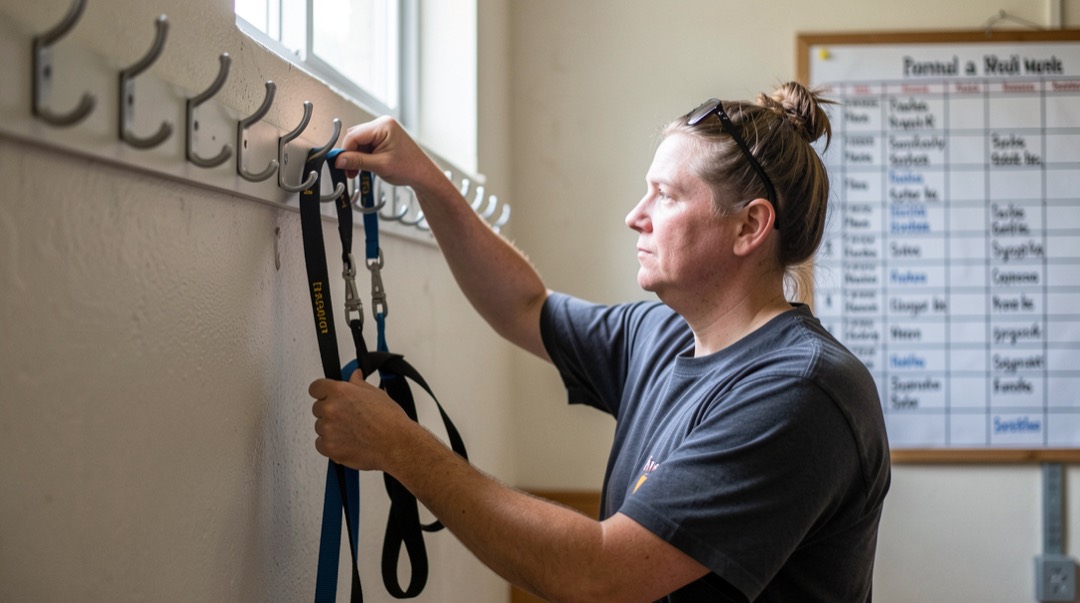
A shelter week does not run on goodwill. It runs on a rota: named people in named slots, each one small enough to be kept. The walking hour on Tuesday, the laundry shift on Thursday, the sign-in desk when the public comes in on Saturday. Visitors see the dogs; the structure that lets them see the dogs is a grid somebody maintains, and the volunteering that keeps that grid alive is the least visible help a shelter receives.
The jobs that make a week hold
Every shelter week is assembled from the same few pieces. There is a rota of walking and cleaning slots, a record of who is trained for what, a welcome point when visitors arrive, and a cover plan for the week the regular cannot come. Each piece is small. Together they are the difference between a shelter that can promise a dog two outings a day and one that promises and apologises.
This is not a shelter invention. Every volunteer run activity survives on the same engine, and the running club world describes it plainly. Lane Six's guides to affiliated clubs and their volunteer roles show how an athletics club fills its own rota, from the taster sessions that let a newcomer try the evening before joining to the named roles that keep a track night alive. The shape transfers without translation: a club or a shelter that cannot fill its ordinary slots stops offering the session, whatever its surplus of enthusiasm on the day.
| Job | What it really is | Why it fails without a named person |
|---|---|---|
| Rota keeper | Matching volunteers to slots and noticing the gaps | An unfilled Tuesday is discovered on Tuesday |
| Sign-in and induction | Greeting, forms, the first rules of the building | New hands drift away when nobody owns the door |
| Kit and laundry check | Counting leads, detergent, clean bedding before the weekend | A shift collapses over a missing box of gloves |
| Cover list | The short list of people who can take a slot at short notice | Illness turns one empty slot into three |
| Log keeper | Making sure what each dog did gets written down | Two weeks of walks vanish into nobody's memory |
None of these jobs strokes a dog. All of them decide whether the dog gets stroked, and that inversion is the first thing a rota volunteer has to make peace with.
The same engine runs every club
The clearest public example is the weekly timed run. parkrun's own volunteering pages list the roles that make one morning happen: marshals, timekeepers, barcode scanners, the person who puts the signs out and the one who puts them away. A shelter's week is identical in structure and slower in consequence. The session exists because the slots are filled, not because people care.
What a season on the rota asks
A season of rota work is unheroic by design. It is the same two hours on the same day, held for three months, with a short message when you cannot make it. The commitment that matters is not length but predictability: a volunteer who keeps a modest slot every week is worth more to the shelter than a generous fortnight followed by silence.
Two habits carry most of the weight. The first is the handover note: a few lines about what was done and what was not, so the next person starts from facts. The second is the absence rule: saying early, the day before rather than the morning after, because a slot reported empty is a slot that can still be covered.
Ask for the slot nobody wants. The unglamorous hour, the early clean, the desk at the quiet open day, is where a new volunteer becomes trusted fastest, because the rota keeper learns your name by its reliability rather than your enthusiasm.
Joining without creating work
A vague offer to help lands on the busiest person in the building as one more task: inventing a job for you. The offer that gets answered names a slot, a frequency and an end date. One line is enough: I can take the Thursday laundry shift, every week until the end of November, and I would like to be shown it once. A coordinator can say yes to that in a single reply.
Then protect the thing you joined. If a week goes wrong, hand it over properly rather than quietly disappearing, and if the season has to end early, say so while there is still time to refill the slot. A resignation done well is still help. If the weekly hour you can actually keep is office shaped rather than kennel shaped, the weekday skills version of the same rhythm may be the better slot, and the long version of rota keeping grows into the coordinator's role.
The honest limit
A rota is infrastructure, and infrastructure is boring precisely when it works. Your season will not produce a story about a dog; it will produce a month in which every walk happened. If what you need is contact with the animals, start with a first walking shift instead, and leave the grid to the people who enjoy it. Both are needed. Only one of them gets thanked.