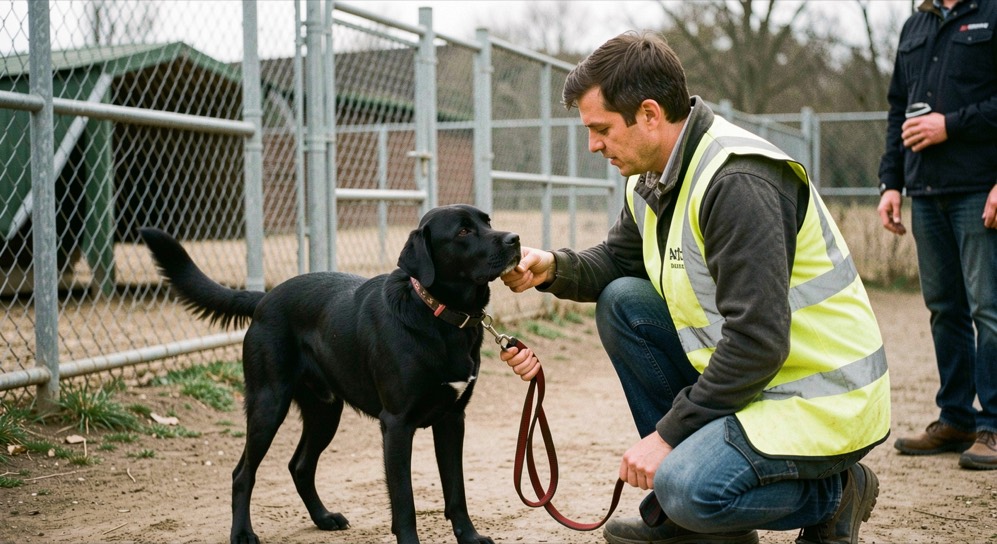
Almost everyone who contacts a shelter wants to walk the dogs, and almost everyone imagines the same afternoon: a lead, a field, a grateful animal. The real first shift is quieter and more procedural than that, and understanding why is what separates the volunteers who last a year from the ones who come twice. A walking shift is a job on a rota, inside a building with rules written after somebody was hurt.
The induction hour
Every shelter that lets strangers handle its dogs runs some form of induction, from a formal half day to twenty minutes with the kennel supervisor. Whatever its length, it exists to transfer four things: how the building works, which dogs you may touch, what to do when something goes wrong, and who to ask.
Expect to be shown the walking route rather than choosing one, and expect a limit on how far you may go. Shelters restrict routes because a dog that slips a collar two streets away is a different emergency from a dog that slips a collar in the yard, and because a dog on a public path is the shelter's legal responsibility while it is on your lead.
Expect also to be given less than you hoped on the first day. One or two dogs, walked in the enclosed area, under supervision, is a normal first shift. That is not distrust; it is the only way anyone can see how you move, whether you read a dog, and whether you follow an instruction you disagree with. Volunteers who treat the first hour as an exam rather than an obstacle are the ones handed the harder dogs in month two.
Which dogs you start with
Shelters sort their dogs into handling levels, sometimes with a coloured card on the kennel door, sometimes only in the staff's heads. A new volunteer starts at the easy end, and the reason is not only your safety. A frightened dog handled badly loses weeks of progress, and the cost of that lands on the dog, not on you.
| Level | Typical dog | Who may walk it |
|---|---|---|
| Green, or unmarked | Sociable, lead trained, no known issues | Any inducted volunteer, from the first shift |
| Amber | Strong on the lead, reactive to other dogs, jumpy, unknown history | Volunteers with some hours behind them, often in pairs |
| Red | Bite history, severe fear, medical restriction, legal case | Staff only, sometimes with one named volunteer |
| No card at all | New arrival still being assessed | Nobody, until the assessment is done |
The card is not a judgement of the dog's character and it changes. Part of what a long term volunteer does is move dogs down that table by working with them, which is the subject of coaching a long stay dog. On your first weekend, walk the green ones well and ask nothing else.
The rules that keep you safe
The rules below appear in some form in almost every shelter, and each one exists because of an incident.
- Two points of attachment. A collar and a harness, or a slip lead over the collar. Most escapes happen in the first minute, at the kennel door, when a dog goes backwards out of a single collar.
- Never open a kennel door with a dog loose behind you. Check the corridor before the latch, every time, including the time you are certain.
- One dog at a time unless you are told otherwise. Two leads in one hand is how a dog fight becomes a hospital visit for the human between them.
- Do not feed anything. Diets and medication are decided by the staff, and a treat from a pocket can also start a fight between kennels.
- Do not take a dog to meet another dog. Introductions are planned, in a chosen space, by people who know both animals.
- If you are uncomfortable, stop. Putting a dog back and saying you were out of your depth is a good shift. Continuing because you feel watched is how people get bitten.
Learn the shelter's emergency procedure on the first day: what to do if a dog gets loose, if two dogs get hold of each other, if you are bitten. In most places the answers are, in order, do not chase, do not put your hands in, and report it however minor it looks. A bite that is not recorded cannot be treated as a known risk for the next volunteer.
What to write down after
Most shelters keep a walking log, and most volunteers write nothing in it. That log is where a dog's profile comes from, and it is the difference between a listing that says friendly and a listing that says something an adopter can act on.
Write three lines. What the dog did on the lead, what it reacted to, and what it enjoyed. Pulled hard for the first five minutes, then settled. Barked at the bins, ignored a passing cyclist. Sat for a scratch behind the ear and did not want to go back in. Those three lines, repeated by different volunteers over a fortnight, are how a shelter learns that a dog is fine with traffic and not fine with wheeled bins, and that sentence sells a dog to the right household.
Report anything physical the same day: limping, a hot ear, blood in the urine, a lump you had not felt before, a refusal to eat. Volunteers see the dogs more slowly than staff do, and this is genuinely the part of the shift where a walker earns their induction.
Then come back next week. The single most valuable property of a walking volunteer is not skill, it is being on the rota, and the dogs that improve most are the ones that see the same person on the same day. Where that becomes a longer commitment, it turns into a season long foster.