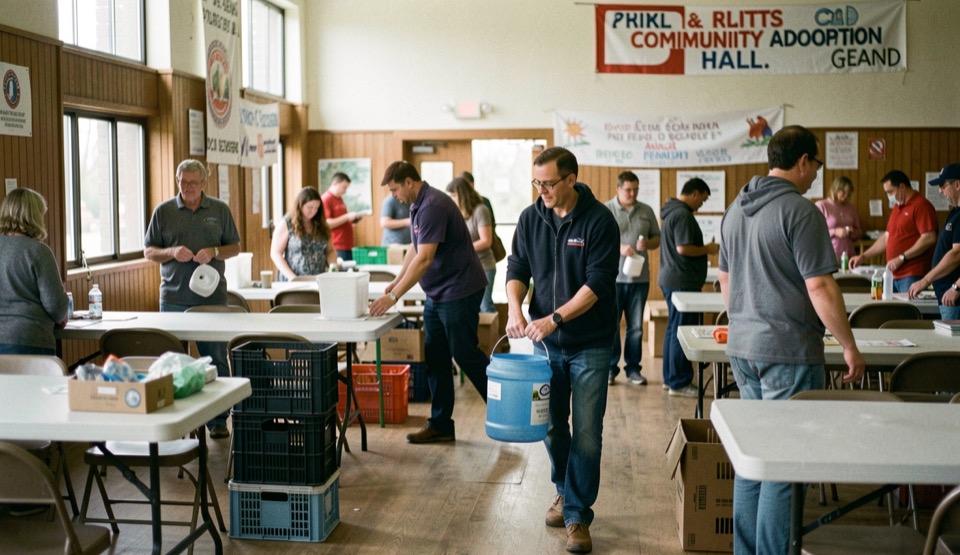
An adoption event is a shelter turned inside out for a day: dogs, staff, paperwork and strangers, in a car park or a hall, with none of the doors and gates that normally make it safe. It is won or lost in the two hours before the public arrives, and the crew that builds it well is doing safety work, not decoration.
The setup, two hours before
Arrive when the van does. The first decision is the shape of the site, and it is made by walking the perimeter and asking one question at every gap: if a dog got loose here, where would it go? The answers decide where the dogs sit, where the public walks and where the exit is.
- Put the dogs at the back, never beside the entrance. A dog next to the door meets every arrival at once and is finished by ten past ten.
- Build a one way flow. People in at one end, out at the other, so nobody backs into a dog while looking at a leaflet.
- Leave a metre and a half between crates or pens. Dogs that can reach each other will, and a fight in public undoes a year of goodwill.
- Make shade and water the first thing you build, not the last. On a warm day this is the whole event.
- Set a quiet zone out of sight. Every event needs somewhere a dog can be taken out of the noise, and it must exist before it is needed.
- Test the table. Paperwork, card reader, pens, spare leads, first aid kit, bin bags, and the phone number of the duty manager written on paper.
Then brief the crew before the doors open, out loud, in one place. Who is on which dog, where the quiet zone is, who calls the stop if the weather turns, and what everybody does if a dog gets loose. That last one takes thirty seconds and is the reason the day does not become a story.
The roles on the floor
An event runs on defined roles. Where everyone is a general volunteer, dogs are handled by whoever is nearest, which is how a nervous dog ends up being petted by a queue.
| Role | Owns | Rule of the role |
|---|---|---|
| Handler | One dog, all day | Never hands the lead to a member of the public, for any reason |
| Floor walker | The space between the dogs | Keeps the flow moving and breaks up crowding before it forms |
| Table | Applications and questions | Takes details rather than making promises about any dog |
| Relief | The rota of breaks | Every dog and every handler comes off the floor on a timer |
| Runner | Water, shade, bags, batteries | Keeps everyone else in place |
| Duty lead | The decision to stop | One named person, and everyone knows who it is |
Rotate the dogs off the floor on a fixed timer rather than by how they look. A dog that seems to be coping in a crowd is often simply frozen, and the handler standing next to it is the worst placed person to notice the change.
Talking to the public
Most people at an adoption event are not adopting today, and treating them as if they were is what makes these days exhausting for everyone. The crew's job is to be accurate and friendly, and to move the small number of serious enquiries to the table.
Say what you know and nothing else. A handler knows what the dog did this morning and what is written on its card; a handler does not know whether it will be good with a two year old, and guessing is how a dog comes back in six weeks. The sentence to have ready is simple: that is exactly the question the adoption team should answer, come to the table and they will go through it with you.
Two questions come up all day and deserve a prepared, honest answer. Why is a dog this nice still here, answered plainly: because he cannot live with cats, or because he is nine, or because nobody has asked. And can my children stroke him, answered by the card and by the dog's state right now, with the child in front of the dog rather than over it, one hand, on the shoulder, for a few seconds.
Never let a member of the public hold a lead. Not for a photograph, not while you fetch water, not because they have had dogs all their life.
The packdown count
The last hour is when accidents happen: people are tired, the barriers are coming down, and the dogs have had a long day. Packdown is a sequence, and the sequence is dogs first.
Load and secure every dog before a single barrier moves. Count them against the list that came out of the van in the morning, by name and by kennel number, and have the person with the list say each name aloud while somebody points at the animal. Count the leads, the crates and the water bowls the same way; the equipment that goes missing at events is what the next event will not have.
Then close the paperwork while it is still fresh. Every application taken, every serious enquiry, every promise made by anybody, written down and handed to the adoption team the same day. An event that produces twelve conversations and no record produces no adoptions, and the crew will be told, wrongly, that the day did not work.
Finally, write down what the site got wrong: the corner that crowded, the pen that caught the sun after two o'clock, the entrance that funnelled everyone past the shyest dog. Next time is the same car park. The dogs on the tables came from good pictures taken on a picture day, and some of them arrived that morning on somebody's leg of a transport relay.