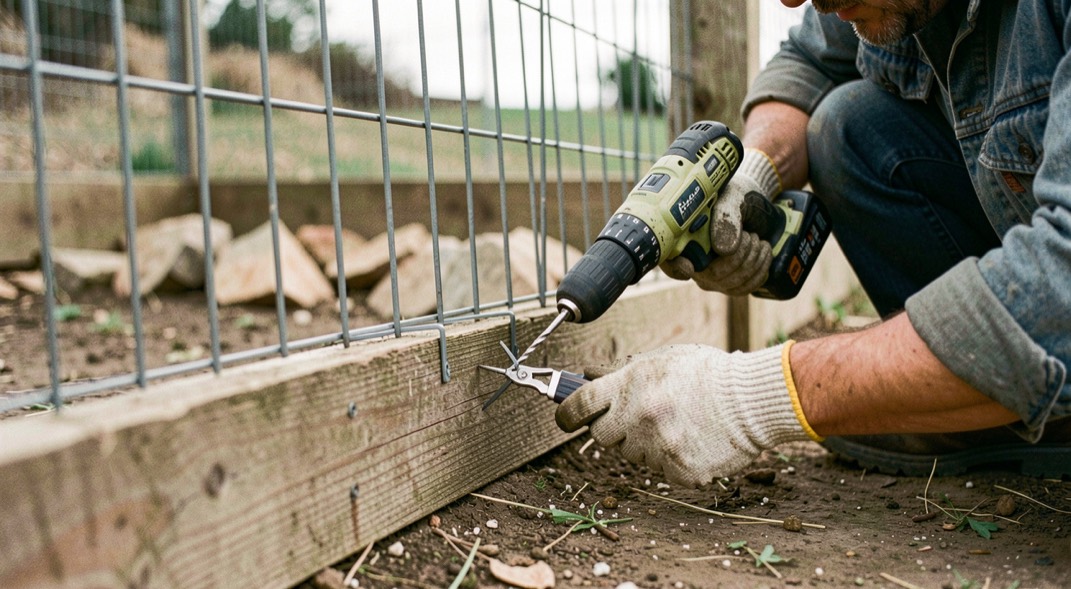
Every shelter has a list of small repairs that has not moved in two years. It is not neglect. It is arithmetic: money spent on a gate is money not spent on a sterilisation, and a shelter will always choose the dog. Which is why a weekend of competent hands is one of the few donations a shelter cannot buy, and why the trades are the volunteers most quietly welcomed and least often offered.
Why the fence waits
Shelter buildings are old, adapted, and used harder than any domestic building. Kennels are hosed daily, so fixings corrode. Dogs chew, dig and throw themselves at things. Everything is disinfected, so paint fails and rubber perishes. The result is a building that generates small faults faster than a small staff can close them.
Meanwhile the staff are triaging. A blocked drain stops the morning clean, so it gets fixed. A latch that needs lifting twice does not stop anything, so it waits, until the day it fails while somebody is holding a dog. Most shelter incidents come from the second category, and it is the category volunteers can clear.
Understanding this changes how you offer. Do not arrive with a plan to build something impressive. Ask for the list of things that have waited longest, and expect it to be dull.
Reading the repair list
Ask for a walk round with whoever knows the building, and write down what you see with three things against each item: what it is, what it needs, and whether it can be done while dogs are in. That third column is the one outsiders forget, and it decides the whole weekend.
| Kind of job | Constraint | Suits a weekend? |
|---|---|---|
| Latches, bolts, door closers, hinges | Kennel must be empty for an hour | Ideal, high safety value, low cost |
| Fence panels, mesh, gate posts | Outside, needs the run empty and secure at the end of the day | Yes, if the run can be closed overnight |
| Drainage, gullies, hose fittings | Must be done before or after the clean | Yes, and it is usually top of the staff list |
| Painting and sealing floors | Fumes and curing time, dogs must be elsewhere | Only with the shelter's plan for moving dogs |
| Electrical and heating | Certification required | Only if you are qualified, and then say so in writing |
| Roofs and structure | Access equipment, insurance | Usually no, this is a quote, not a favour |
Say plainly what you are qualified for and what you are not. A shelter that accepts an unqualified electrical repair carries the consequence, and a volunteer who overstates their trade is a liability rather than a gift. Doing three simple jobs properly is worth more than starting one you cannot certify.
The toolbox that travels
Assume the shelter has almost nothing, that what it has is blunt, and that the nearest hardware shop closes at midday on Saturday. The kit below covers most of what a repair list actually contains.
- Cordless drill and driver, with spare batteries. The single most useful object on site.
- Angle grinder and a hacksaw. Corroded bolts are the recurring obstacle in a hosed building.
- Stainless or galvanised fixings, in quantity. Anything else rusts out within a year in a kennel.
- Fence pliers, wire, tensioning tools, spare mesh. Fence work is the most requested outdoor job.
- Silicone, exterior filler, penetrating oil, cable ties. The consumables that finish a job rather than half finish it.
- Your own gloves, glasses, ear protection and a first aid kit. Do not assume the shelter has any of it.
- A dustpan, a brush and bin bags. Leaving swarf, screws or offcuts in a dog area turns a repair into a veterinary bill.
Bring more fixings than you need and leave the surplus. A drawer of the right screws is itself a donation, and it is what lets the staff do the next small job without a trip to town.
Jobs one weekend finishes
The point of a weekend is to close items, not to open them. A half stripped door on Sunday evening is worse than the door you found on Saturday morning, because the kennel behind it is now unusable.
Realistic for two days with two people: every latch and bolt in one block replaced with a type that works one handed, because a handler holding a lead has one hand. A run of fence mesh re tensioned and the bottom edge buried or pinned, which is the standard escape route. Every gate hung so it self closes, or at least so it does not stand open on its own. Drain covers cleared, hose fittings replaced, taps that no longer drip into a run. Kick plates on the doors the dogs scratch through.
Finish each item completely, including the sweep up, before starting the next. At the end, walk the list with a member of staff, mark what is done, and write down what you found and could not fix, with the parts needed. That written list is the second half of the gift: it turns a vague worry into something the shelter can quote, fund or hand to the next volunteer.
If your trade is not physical, the same logic applies to the office, and that is the subject of giving a shelter your weekday skills. If you liked the two days and want the version with dogs in it, the other weekend jobs are an adoption event crew and a first walking shift.