Bedding is the only thing in a shelter that is destroyed daily and replaced by strangers. A kennel goes through it faster than food, because food is eaten once and bedding is soiled, chewed, laundered, shrunk and thrown away. An afternoon spent on bedding is therefore one of the few gifts that lands exactly where the shelter is thinnest, provided what you bring survives the machine.
Why bedding is the first need
A dog that sleeps on bare concrete loses heat through the floor and shows it: pressure sores on the elbows, stiffness in the morning, and the kind of restlessness that a visitor reads as a difficult temperament. Bedding is not comfort in a shelter, it is basic veterinary maintenance, and it is also the thing that makes a kennel photograph like a place a dog could live rather than a holding pen.
The problem is throughput. Every soiled item goes through a hot wash, and a shelter laundry runs from opening until the last round of the evening. That machine sets the rules: what fits, what survives, what jams the drum, what still smells after two cycles. Anything that fails one of those tests is not bedding, it is landfill that a volunteer has to carry out.
This is why a shelter that has plenty of blankets will still ask for washing powder, and why the two requests belong together. If you are bringing bedding, bring the means to wash it as well; the pairing is the part that people who read the wish list first already know.
Fabrics that survive the wash
Judge a donation the way the laundry will. It has to go in flat, come out clean at high temperature, dry fast enough to be back in a kennel the same day, and not shed a filling if a dog opens it.
| Material | Hot wash | Drying | Verdict |
|---|---|---|---|
| Polar fleece, flat | Excellent, does not hold odour | Very fast | The workhorse of every kennel |
| Cotton towels and sheets | Excellent | Slow but reliable | Always useful, especially for intake and grooming |
| Vet bed and similar drainage bedding | Designed for it | Fast | The best there is, and the most expensive |
| Quilted duvets and pillows | Heavy, slow, often refused | Days | Ask first, the filling is the problem |
| Foam beds with fixed covers | Cannot be laundered | Cannot dry | Refused almost everywhere |
| Wicker, wood, wire baskets | Cannot be disinfected properly | Not applicable | Refused, and a chewing hazard |
Two practical notes. Fleece sold by the metre is cheap and needs no hemming, because it does not fray; a rectangle cut with scissors is a finished kennel blanket. And colour is not decoration: pale fabric shows blood and discharge that dark fabric hides, which is why intake and post operative areas often ask for white towels specifically.
Sewing a kennel mat in one afternoon
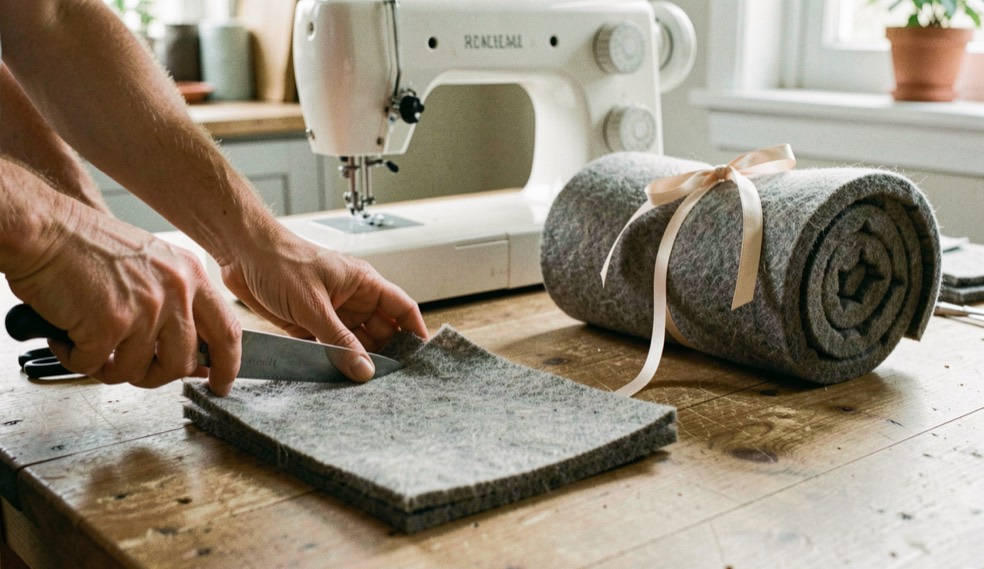
If you have a sewing machine, the most useful thing you can make is not a dog bed. It is a flat, machine washable mat that stacks: no zip, no piping, no filling that migrates into a corner. The method below is deliberately crude, because a shelter mat has a life expectancy measured in weeks.
- Cut two rectangles of fleece to the kennel size the shelter gives you. Ask for the size, do not guess; runs differ, and a mat that does not fit is folded and then chewed at the fold.
- Put the two layers together. Do not add wadding: it clumps in the wash and turns the mat into a bag of lumps after three cycles.
- Stitch all four edges with a straight seam close to the edge, then a second seam a centimetre inside the first. The second line is what keeps the mat together after a dog has worried the corner.
- Quilt across the middle in a grid of squares roughly the width of your hand. This is the step people skip, and it is the one that stops the layers separating in the drum.
- Trim the corners round. A square corner is a handle for teeth.
Four or five of these is a realistic afternoon, and a stack of identical mats is worth more to a shelter than one elaborate bed, because identical things can be counted, rotated and replaced. If you have no machine, the same afternoon can be spent cutting and hemming nothing at all: fleece rectangles, washed, folded, labelled with the size.
Toys: the safe short list
Toys are a veterinary question in a shelter, not a treat, because the staff cannot supervise a kennel at three in the morning. The rule that governs everything is simple: a toy that can be taken apart will be taken apart, and the pieces will be swallowed. One category sits deliberately between the indestructible and the forbidden: destructible enrichment, plain card a dog is meant to take apart under supervision, which most kennels accept because the pieces are pulp rather than plastic.
- Solid rubber, no seams, too large to swallow. The one category shelters genuinely run out of, because it survives dog after dog and is expensive.
- Thick rope with knotted ends, only where the staff allow it. Useful, but strands are swallowed, so many kennels use them only under supervision.
- Hard plastic balls sized above the dog's throat. Ask which size; a ball that fits behind the tongue is a killer, and every shelter has a story.
- Nothing with a squeaker, plastic eyes, ribbon or stuffing. Soft toys are lovely in a home and are a surgical bill in a kennel.
- No edible chews unless the shelter asks. Diets, medication and resource guarding all make a chew a decision the staff have to take.
Ask before you buy, deliver clean and flat, and accept a refusal without argument. The stack you leave at reception this afternoon becomes routine only if it repeats, which is the whole argument of running a standing collection instead of a single delivery.