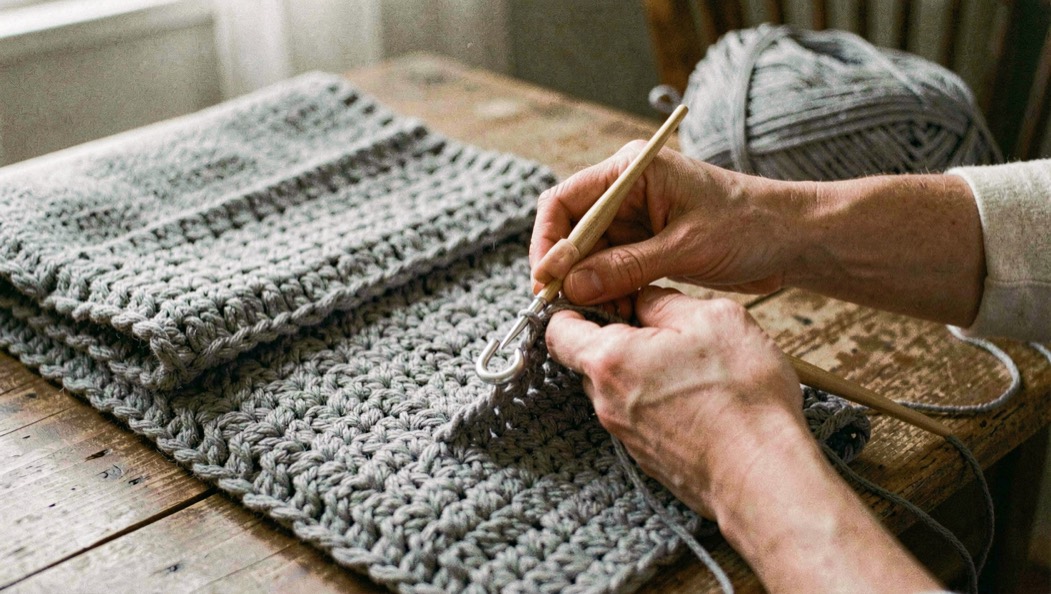
A crocheted blanket is the textile cousin of the sewn kennel mat: a piece of warmth a dog can knead, sleep on and carry to the next place it lives. It is also the version most likely to arrive wrong, because a blanket made for a sofa and a blanket made for a kennel are different objects. The difference is decided before you cast on, by the shelter's laundry, by the size of the run and by what a paw does to a loose loop.
Ask the kennel before you cast on
The first step is not a pattern, it is a question. Shelters differ on handmade bedding: some launder everything daily at high temperature and will take only what survives it, some refuse anything with a loop a claw can open, and many want a size that matches their runs rather than your sofa. Read the wish list first, then ask specifically about crocheted pieces: the dimensions that fit, the fibres they accept, and whether they want finished blankets or squares their own volunteers join.
When the shelter says yes, the craft side is already documented. Stitch Ledger keeps a workbasket of free patterns, gauge guides and charity crochet notes, including the sizes and constructions that charity projects actually accept, which is precisely the reading a first kennel blanket needs.
Yarn and stitch: what survives the wash
The shelter's machine is the real client. Whatever you make has to go in flat, come out clean at high temperature, dry fast and release no loose fibre a dog can swallow. That rules out more than it permits.
| Choice | In the machine | Verdict |
|---|---|---|
| Plain acrylic, medium weight | Survives hot cycles, dries fast, keeps colour | The workhorse, and the one most charities name |
| Cotton, worked dense | Survives but dries slowly and heavy | Acceptable, ask first |
| Wool and wool blends | Felts and shrinks at kennel temperatures | Skip for shelters, keep for home |
| Chunky and super bulky yarn | Heavy wet, slow to dry, catches on mesh | Skip |
| Open lace and filet stitches | Claws enter the holes and tear them wider | Skip: the structure itself is the risk |
| Fringe, tassels, pom-poms | Come off and get swallowed | Never, whatever the pattern shows |
Choose the stitch the way you choose the yarn: dense and closed. Single crochet, moss stitch, a tight granny worked without gaps between the clusters, all produce a fabric a paw cannot unzip. Work the gauge tighter than the ball band suggests, because a dense square wears longer and traps less in the drum.
The makers already do this
You are not inventing a practice. The Snuggles Project has organised handmade blankets for shelter animals for decades, keeping a directory of shelters that accept them and a standard for what a comforting, washable piece looks like. Reading their guidance is the fastest way to learn the shape the shelter world expects, and the same shapes work when a local kennel is your only client.
The useful lesson from every charity making scheme is the same: the shelters want boring excellence, not one beautiful piece. A stack of identical washable mats can be counted, rotated and replaced, and a crocheter who produces five plain dense blankets does more than one who produces a single elaborate throw.
Make it flat, washable, countable
- Match the size to the run or carrier base the shelter names. A blanket that fits lies flat; one that does not gets folded, and a fold is where chewing starts.
- Work a border in the same dense stitch, two or three rounds, to hold the corners down and square the edges.
- Weave every end in twice, in two directions. A buried tail is invisible; a loose one is a thread a dog pulls until the corner opens.
- Wash and dry the finished piece on a hot cycle before delivery. It proves the blanket survives, and it arrives clean enough to go straight into a kennel.
- Label it with the size and the fibre on a strip of tape. The laundry learns what it can do with the piece without asking anyone.
The honest limit
A crocheted blanket is comfort, not rescue: it makes a hard week in a kennel softer and it photographs a dog as an animal rather than an inmate, which quietly helps the adoption pages. Deliver it the way bedding is delivered, flat and labelled at a quiet hour, and if the making becomes a habit, the version a shelter can plan around is a standing monthly delivery. The sewn sibling of this page, for those with a machine rather than a hook, is the blankets and toys guide.